Topic Hub
Birmingham Summer AC & Cooling — The Complete Guide
Heat-wave troubleshooting, frozen coils, thermostat setpoints, electric-bill math, and the maintenance habits that get a Birmingham home through August. Every Lockwell summer-cooling guide in one place.
01 · What this covers
Why we built this hub.
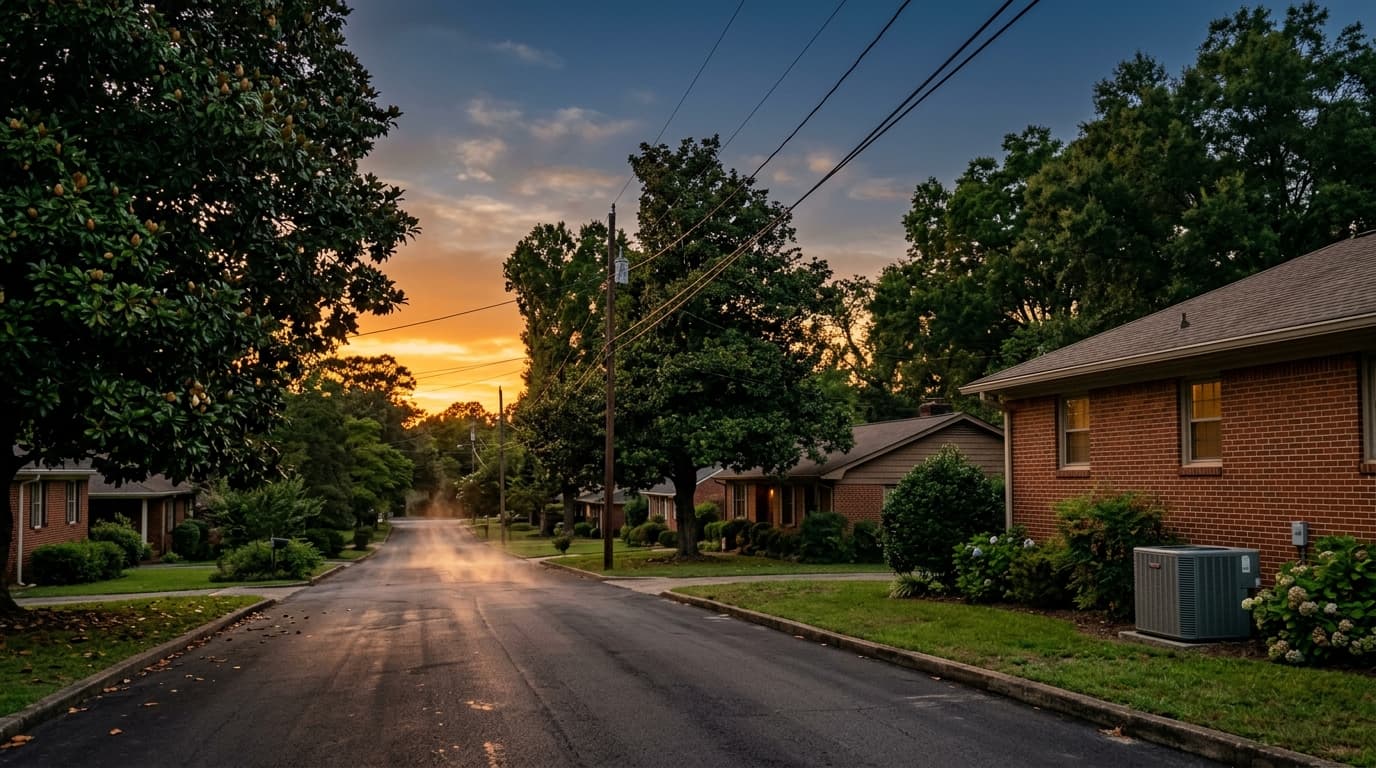
This is the Lockwell HVAC summer-cooling hub for Birmingham, Alabama. Every blog post, service page, and area page that touches keeping a North Birmingham home cool from May through September lives here.
Birmingham summers run long, hot, and humid. Heat indexes regularly hit 105 in late July, and the cooling season runs from late April through October. That puts more runtime hours on a residential AC than almost any other US climate zone — and it shows up as failures clustered in the same window every year.
Use the components grid to jump to the specific problem. If you have an emergency right now, call dispatch — we run service trucks through Gardendale, Bessemer, Irondale, Center Point, and Helena 24/7 in cooling season.
02 · The Birmingham angle
Why Alabama makes this different.
Birmingham gets roughly 2,200 cooling-degree days per year — well above the national average. The cooling load profile is dominated by humidity rather than dry-bulb temperature, which means the system has to remove latent heat (water vapor) for hours at a time. Oversized systems short-cycle and leave humidity high; correctly-sized systems run long, slow cycles that pull moisture out of the air.
Pollen season runs March through May with a secondary peak in September. Cottonwood, oak, and ragweed clog outdoor condenser coils and air filters faster than in drier climates. A condenser coil that has lost 30 percent of its airflow drives head pressure up, which drives compressor temperature up, which kills compressors years early.
Older neighborhoods like Center Point, Hueytown, and parts of Bessemer often run AC equipment past its design life because the cooling load on a smaller home is manageable for an aging system. The trade-off is sudden failures in July — those are the calls that book two weeks out.
03 · The components
Every guide on Birmingham summer cooling.
Thirteen resources covering diagnostics, frozen coils, electric-bill math, maintenance, and the area pages where we run cooling-season service routes.
Blog · Diagnostic
What's Wrong With My Air Conditioner?
Top failure modes a Birmingham tech checks first — capacitor, contactor, refrigerant, condenser fan, frozen coil, thermostat.
Blog · Diagnostic
How to Diagnose an Air Conditioner
A homeowner-safe diagnostic walkthrough — what you can check before the truck arrives and where to stop.
Blog · Frozen Coil
AC Freezing Up — Causes and Fixes
Why evaporator coils freeze in Alabama humidity, the order to check, and the cheap-fix-vs-call-a-tech decision tree.
Blog · Setpoints
High Electric Bills in Alabama Summer — What To Do
Setpoint math, runtime hours, and the system-side problems that make summer bills explode.
Blog · Maintenance
Cost of Skipping AC Maintenance
Real failure-cost math for skipped tune-ups. The $25 capacitor that becomes a $4,500 compressor.
Blog · SEER
SEER Ratings Explained for Birmingham
SEER vs SEER2, federal minimums, and the efficiency tier that pays back in our long cooling season.
Blog · Filters
How Often to Change Your Filter in Alabama
Pollen and runtime hours mean Alabama filters clog faster than the box says. Here is the cadence.
Blog · Air Quality
Mold in Air Ducts in Birmingham
Why summer humidity and AC condensation create mold conditions, and the IAQ steps that actually work.
Service · AC Repair
AC Repair
Capacitor, contactor, refrigerant, fan motor, control board diagnosis. Written estimate before any work begins.
Service · Maintenance
HVAC Maintenance Plans
Spring tune-up + fall tune-up. Documented readings, manufacturer-warranty paper trail.
Service Area
Birmingham, AL HVAC
Downtown, Five Points, Highland, and the urban core — older housing stock with summer-runtime challenges.
Service Area
Bessemer, AL HVAC
West-side Birmingham metro. Older housing stock that often runs aging equipment through Alabama summers.
Service Area
Helena, AL HVAC
South Shelby County subdivisions with newer equipment but full Alabama-summer cooling load.
04 · Common questions
What homeowners ask us first.
What temperature should I set my thermostat in summer in Birmingham?+
ENERGY STAR recommends 78 degrees when home and 85 degrees when away. Each degree below 78 adds roughly 3 percent to your cooling cost. In Birmingham humidity, 78 with the system running long, slow cycles produces a more comfortable home than 72 with short cycles — because runtime is what removes humidity. A programmable or smart thermostat with humidity control is worth the upgrade.
Why is my AC running but not cooling?+
Most common in Birmingham summer: (1) Frozen evaporator coil from a clogged filter or low refrigerant — the coil ices over and air flows around the ice instead of through it. (2) Failed capacitor — the compressor or condenser fan stops running but the indoor blower keeps moving air. (3) Dirty condenser coil — pollen and cottonwood block heat rejection so refrigerant cannot dump heat outside. Check the filter and the outdoor unit first; everything else needs gauges and a meter.
How long should an AC run during a heat wave?+
A correctly-sized AC will run almost continuously during peak Birmingham summer afternoons — that is normal and desirable. Continuous runtime keeps humidity down and the temperature stable. Short cycles (on for 5 minutes, off for 10) usually mean the system is oversized or has a refrigerant or airflow problem. If a long run cycle holds your setpoint within 2 degrees, the system is doing its job.
Why does my electric bill spike in July?+
Three drivers, in order. (1) Cooling-degree days roughly double from May to July, so runtime hours roughly double. (2) Setpoint creep — homeowners drop the thermostat from 78 to 72 to "fight" the heat, adding 18 percent to cooling cost. (3) System efficiency drift — a system that has lost a half-pound of refrigerant or has a half-clogged condenser coil burns 10 to 30 percent more electricity. Maintenance addresses #3, behavior addresses #2.
Should I cover my outdoor AC unit in summer?+
No. The outdoor unit is designed to operate in full Alabama sun, summer rain, and direct weather. Covering it traps moisture, encourages corrosion, and blocks the airflow the condenser needs to reject heat. The only valid reason to cover the unit is a winter cover designed to keep falling debris (leaves, twigs) out of the coils — and even then, only when the system is off for the season.
How do I keep my AC from breaking in July?+
Schedule the spring tune-up by mid-April. Change the filter every 30 days from May through September. Keep two feet of clearance around the outdoor unit and rinse the condenser coil with a garden hose monthly. If the system is over 12 years old, get the capacitor and contactor checked — those are the two parts that fail first under summer load and they are cheap to replace before they take the compressor with them.
Is it cheaper to leave the AC on all day or turn it off?+
Set it back, do not turn it off. ENERGY STAR research shows setting the thermostat 7 to 10 degrees higher when away (85 instead of 78) saves roughly 10 percent on cooling cost over a season. Turning the AC off entirely lets indoor humidity climb to 70+ percent, and the recovery cycle when you get home is brutal. A smart thermostat with geofencing handles this automatically.
05 · Next step
AC down in the heat? Call dispatch.
We run trucks through North Birmingham around the clock during cooling season. Tell us what the system is doing — we will tell you what to check before we get there, and dispatch the right technician to your door.
Call (205) 206-7030