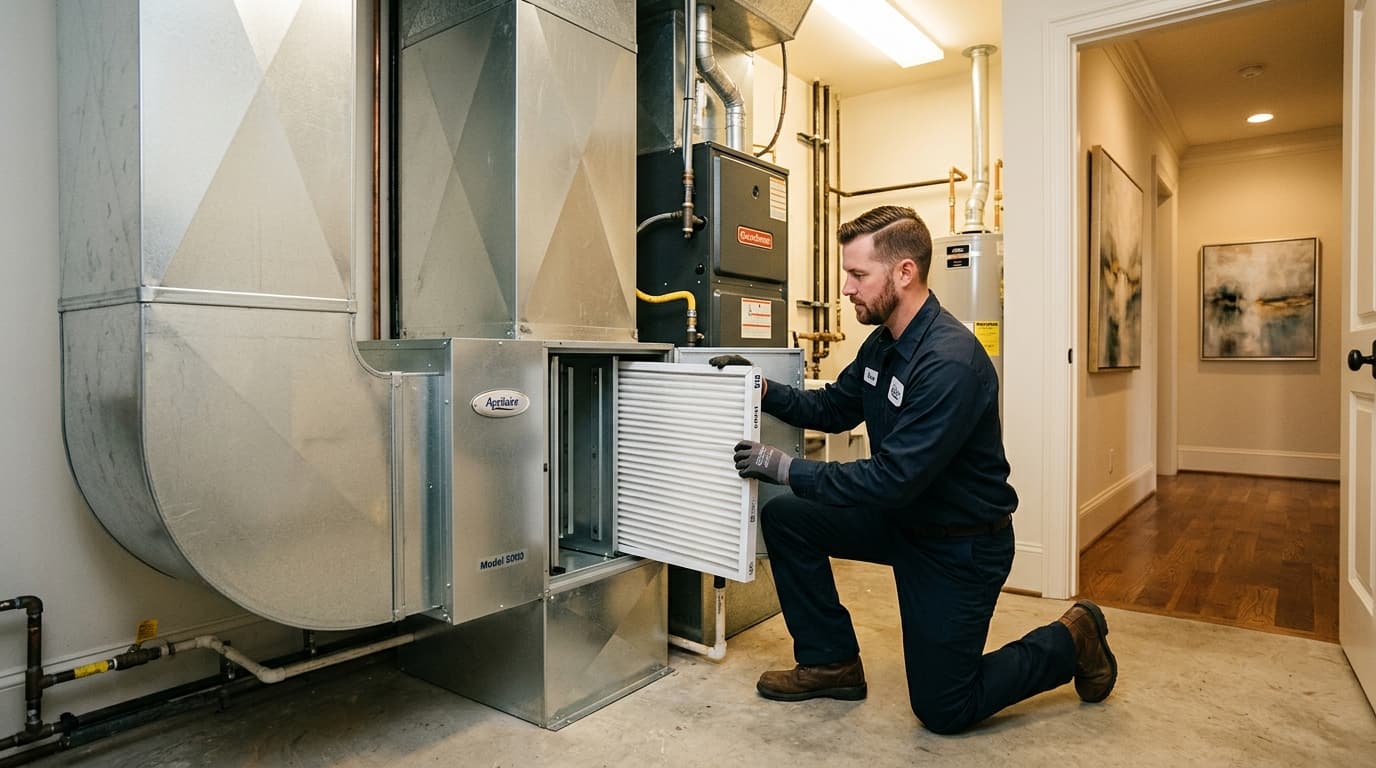
Whole-House Media Air Filtration for North Birmingham Homes
Why a One-Inch Filter Is Not Enough on a Premium System
The standard one-inch fiberglass filter at the return-air grille of a typical home was never designed to do real work. It catches the largest particles — visible dust, pet hair, the occasional cobweb — and lets essentially everything smaller pass through. On a premium HVAC system, that level of filtration is not a match for the equipment investment.
Owners renovating premium homes in Mountain Brook, Vestavia Hills, and Homewood increasingly ask the right question: if the air conditioner is a variable-speed inverter unit, the furnace is a 99 AFUE modulating model, and the duct system has been engineered for the equipment, why is the filter at the return grille still the same one-inch product available at the home improvement store?
A whole-house media filter cabinet is the answer. Four to six inches deep instead of one. Pleated media with three to twenty times the surface area of the one-inch product. Filtration rated by MERV — Minimum Efficiency Reporting Value — at MERV 11, MERV 13, MERV 16, or even HEPA-equivalent depending on the equipment. The result is meaningfully cleaner indoor air and a meaningfully cleaner HVAC system.
Quick Reference Guide
How a Whole-House Media Filter Actually Works
The cabinet installs at the return-air side of the air handler. Return air from the house passes through the cabinet before reaching the equipment, which means every cubic foot of air the system circulates passes through the media filter every cycle.
The media itself is a pleated paper-and-synthetic-fiber product with much more surface area than a one-inch flat filter. More surface area means lower air-pressure resistance at the same filtration rating — which matters because air-pressure resistance at the filter is added to the static-pressure load on the blower motor. A premium HVAC system is engineered around a specific static-pressure budget, and the filter has to live inside that budget.
This is the detail that makes "more filtration is always better" wrong. A MERV 16 filter with too little surface area can starve the air handler, drop airflow below the design point, and produce frozen evaporator coils in summer and cracked heat exchangers in winter. The right filter is the highest MERV rating the system can handle without dropping below the design airflow — which is a function of the cabinet size, media depth, and filter surface area, not just the MERV rating on the label.
We size the filter cabinet to the equipment, not to the homeowner's enthusiasm for high MERV numbers.
What MERV Actually Means
MERV is a standard rating scale from MERV 1 through MERV 20 measuring the percentage of particles of various sizes that the filter captures.
MERV 8 is roughly the rating of a thick pleated home-improvement-store filter. Captures large particles, dust, pollen, some pet dander. Acceptable as a minimum but not where premium installs should land.
MERV 11 captures more fine dust, some mold spores, finer pet dander, and some bacterial particles. A reasonable baseline for premium media cabinets in homes without specific air-quality concerns.
MERV 13 is where the conversation gets interesting. This rating captures most of the particles in the 1-to-3-micron range, which includes most bacteria, smoke particles from cooking and wildfires, and many viral particles attached to larger droplets. The CDC and ASHRAE both reference MERV 13 as the practical residential target for healthier indoor air.
MERV 16 captures essentially everything down to the 0.3-micron range — including most fine smoke, some viruses, and the finest indoor airborne particles. This is the highest rating that works on most residential systems without specialized cabinetry. HEPA-equivalent filtration above MERV 16 is generally limited to specialty applications.
For most premium North Birmingham homes, the right answer is a properly-sized MERV 13 or MERV 16 cabinet. Higher MERV ratings deliver diminishing returns and increase the risk of starving the air handler.
The Cabinets We Specify
A few products earn most of our recommendations.
**Aprilaire Model 2410 and 1410** media cabinets are workhorses. Four-inch and six-inch depth options, pleated media replacements rated MERV 13 or MERV 16, easy access for filter changes, and integration with Aprilaire indoor air quality controllers. Reliable, well-priced, and serviceable for decades.
**Aprilaire Model 5000** is the electronic air cleaner option in the lineup. It uses an electric polarization stage upstream of a pleated filter to attract finer particles to the media. Captures more fine particles than passive filtration alone and runs at lower static-pressure resistance. Premium tier of the category.
**Honeywell F100 and F300** media air cleaners cover the same ground from a different manufacturer. F100 is a passive media cabinet at MERV 11; F300 is an electronic cabinet competing with the Aprilaire 5000.
**Trane CleanEffects** is the field-charged electronic option that pairs with Trane equipment for full system integration. Removes particles down to 0.1 micron at very low static-pressure penalty. The premium tier on Trane installs.
The right cabinet depends on the equipment, the duct configuration, the homeowner's air-quality goals, and the budget. We quote the option that fits.
Static Pressure Is the Boundary Condition
Every premium air filtration install starts with measuring static pressure on the existing system. A manometer reads supply-side and return-side pressure during operation, and the result tells us what the air handler is doing and how much headroom exists for filter resistance.
Most residential air handlers are rated for 0.5 inches of water column total external static pressure. Many existing systems already run close to or above that ceiling because of accumulated duct restrictions, undersized return grilles, and poorly sized filter slots. Adding a high-MERV filter on top of an already-stressed duct system makes the problem worse.
When we find a system running outside spec, we tell the homeowner. Sometimes the right answer is duct work to relieve the static-pressure load before adding the premium filter. Sometimes the right answer is a larger filter cabinet that delivers high filtration at lower resistance. Sometimes the right answer is to start with MERV 11 and confirm the system handles it before moving up to MERV 13 or MERV 16.
Maintenance Intervals on Media Filters
Media filter cabinets need filter replacement on a schedule. Four-inch pleated media at MERV 13 typically runs six to nine months between changes depending on indoor air conditions. Six-inch deep cabinets stretch the interval to nine to twelve months. Electronic air cleaners need the polarization stage cleaned annually and the media changed on a similar schedule.
The biggest cause of complaints in the category is forgotten filter changes. A pleated media cabinet that has not been serviced in two years restricts airflow severely, drops cooling and heating performance, and accelerates equipment wear. We include filter inspection and replacement in our maintenance-plan visits so the equipment continues to perform.
Stocking the right replacement media on hand is part of the service. We carry Aprilaire and Honeywell replacement cartridges for every cabinet we install.
What Premium Air Filtration Will and Will Not Do
It will dramatically reduce visible dust on hard surfaces. It will reduce indoor allergen levels — pollen, mold spores, fine pet dander, fine smoke from cooking and wildfires. It will reduce the soot accumulation on the evaporator coil that gradually degrades cooling performance over time. It will improve the air quality measurement on residential indoor-air-quality monitors.
It will not eliminate odors from cooking, pets, or cleaning products. Activated carbon stages are the right tool for odor reduction, and they are typically a separate cabinet or an integrated carbon layer on certain electronic units. We install carbon stages on jobs where odor reduction is a stated goal.
It will not solve a home with bad ductwork or excessive infiltration. If conditioned-and-filtered air leaks out and unconditioned-and-unfiltered air leaks in, the filtration story is incomplete. We test duct leakage and recommend sealing work as part of the conversation.
Why Homeowners Pick Lockwell for Premium Filtration
We install whole-house media filtration as part of premium HVAC upgrades and as standalone retrofits on existing systems. Every install starts with measuring the system, confirming the static-pressure budget, and quoting the right cabinet and MERV rating for the specific equipment and home.
Every Lockwell technician is EPA Section 608 certified, working under the Alabama HVAC contractor license of John M. King (#2020068). We pull required permits, register equipment under manufacturer warranty, and include filter service in our maintenance plans so the system continues to perform.
Call (205) 206-7030 to schedule an air-quality assessment. The first visit measures static pressure, inspects the existing return-air configuration, asks what air-quality concerns the homeowner is trying to address, and quotes the right system in writing.
Premium Air Filtration — Frequently Asked Questions
Prepared by the field technicians at Lockwell HVAC in Gardendale, Alabama. This page reflects how we actually diagnose, repair, and install equipment on residential service calls across the North Birmingham metro — what we measure, what we replace, and how we verify the work before we leave.
Premium Air Filtration Service Area
Lockwell HVAC provides premium air filtration for homes in 9 North Birmingham metro communities. We do not service Hoover, Vestavia Hills, Mountain Brook, Trussville, or cities outside Jefferson and Shelby counties.
- [1]ASHRAE 52.2 MERV rating standard for residential and commercial air filtration — ASHRAE — American Society of Heating, Refrigerating and Air-Conditioning Engineers
- [2]CDC guidance on improving ventilation and filtration in buildings — Centers for Disease Control and Prevention — Ventilation in Buildings
- [3]EPA Guide to Air Cleaners in the Home — U.S. Environmental Protection Agency — Indoor Air Quality (epa.gov/indoor-air-quality-iaq)
- [4]Aprilaire Model 2410, 1410, and 5000 whole-house air cleaner specifications — Aprilaire — Research Products Corporation (aprilaire.com)
- [5]Honeywell F100 and F300 media air cleaner specifications — Resideo / Honeywell Home (honeywellhome.com)
Bookmark this page for reference. Share it with a neighbor who might find it useful. If you have questions about anything covered here, call us directly — a real person answers, not a recording.