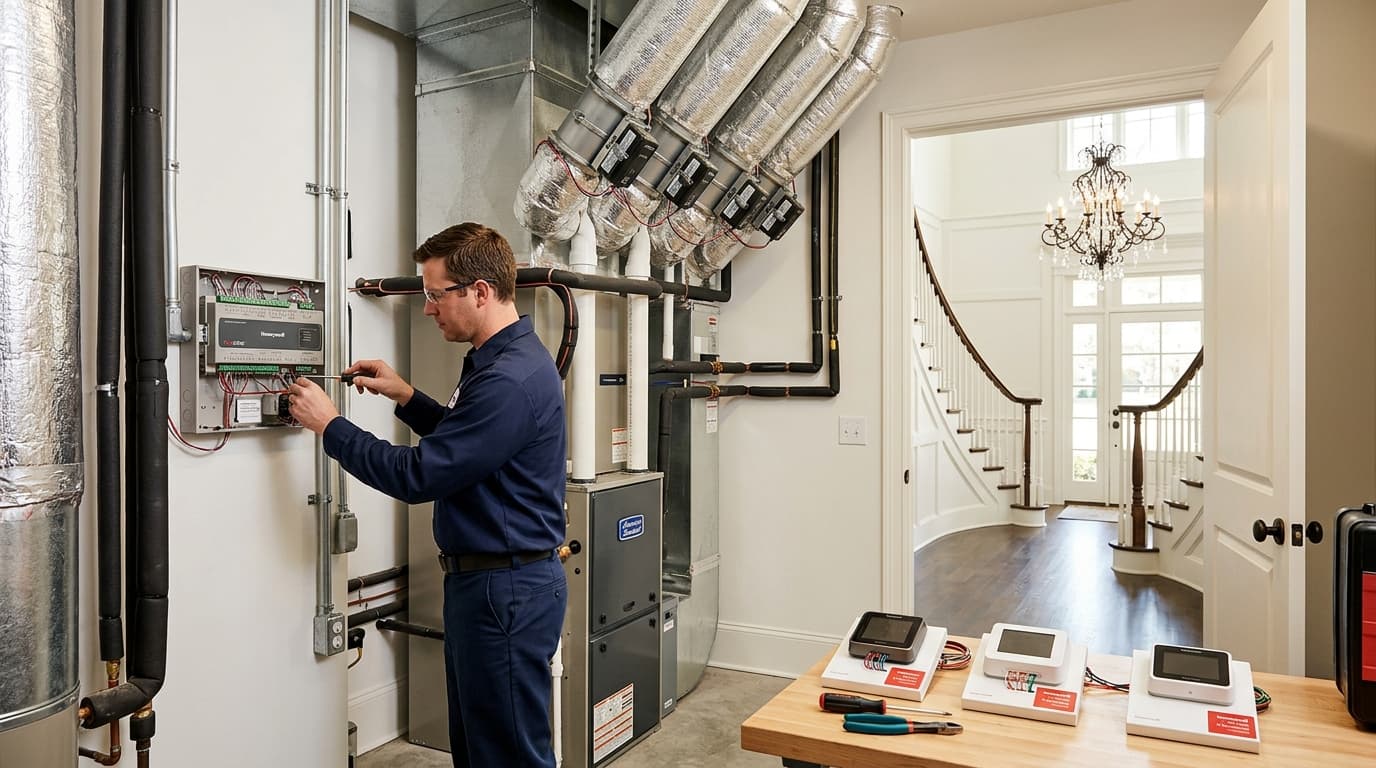
Multi-Zone HVAC System Design for North Birmingham Homes
The Problem Zoning Solves
Two-story homes have a comfort problem that one thermostat cannot fix. The upstairs runs hot in summer because warm air rises. The downstairs runs cold because cool air settles. Or — in winter — the downstairs is comfortable while the upstairs cooks because the furnace pushes hot air into a return that is satisfied long before the upper level catches up.
Add wings, additions, basement living spaces, sunrooms, and finished bonus rooms over garages, and the single-thermostat house gets less and less honest. Some rooms are right, some rooms are wrong, and the thermostat is winning the argument every time.
Zoning fixes this. One air handler, one outdoor unit, but the system pretends it is two or three or four independent systems. Each zone has its own thermostat, its own demand, and its own motorized damper that opens and closes to deliver air only where the room is calling for it. Done right, every room in the house gets to the temperature the homeowner picked.
Quick Reference Guide
What a Properly Engineered Zone System Actually Looks Like
A zone system is not a hardware product — it is a duct-system engineering exercise. The zone panel, dampers, and thermostats are the controls. The ductwork, equipment, and bypass strategy are what make those controls actually work.
The starting point is the same Manual J load calculation we run on every premium install. The cooling-and-heating load gets calculated room by room and then summed by zone. The duct system gets sized by Manual D to deliver that load to each zone at the right static pressure with the right CFM. The equipment gets matched to the largest single zone demand plus the bypass strategy.
When that engineering is done first, the resulting zone system feels invisible. The right rooms get the right air at the right time, and the equipment runs efficiently because the duct system was designed to handle the variable airflow that zoning produces.
When that engineering is skipped — when a contractor drops dampers into an existing duct system that was sized for a single zone — the system limps along, the equipment short-cycles, the bypass dumps conditioned air into the return, and the homeowner gets frustrated. We see retrofits of bad zone installs constantly. We do not produce them.
The Equipment We Specify
Two zone control platforms earn most of our recommendations: Honeywell TrueZONE and EWC Controls Ultra-Zone. Both are mature, well-supported platforms with reliable damper actuators, clear control logic, and integration with the major premium thermostat lines.
Honeywell TrueZONE HZ322 and HZ432 panels handle two-zone, three-zone, and four-zone configurations and integrate with Honeywell, Carrier Infinity, and most major communicating thermostats. EWC Ultra-Zone NCM300 and similar panels do the same on a slightly different platform and earn the install on projects where their specific configuration fits better.
Motorized dampers go in the supply ductwork at the takeoff to each zone. Spring-return dampers fail open — meaning if a damper actuator fails, the zone gets full airflow and the homeowner does not get a cooked room or a frozen evaporator coil. We do not install power-open-power-close dampers on residential work because the failure mode is bad.
Thermostats match the system. On a Carrier Infinity system, Carrier Infinity thermostats in every zone communicating back to the zone panel. On a Trane ComfortLink II system, Trane thermostats. The whole point of premium communicating equipment is that the system pieces talk to each other — mixing brands gives up that capability.
Bypass and Dump-Zone Strategy
A zone system has to do something with conditioned air that is generated when fewer zones are calling for service than the equipment was sized for. If the upstairs zone is satisfied but the downstairs is still calling, the equipment may produce more airflow than the downstairs ductwork can deliver against its static-pressure capacity.
Two solutions exist. A bypass damper dumps excess airflow from supply back into return. A dump zone is a designated zone that always gets airflow regardless of its thermostat — typically a basement, a hallway, or a less-occupied space. Each strategy has tradeoffs.
We size and configure the bypass strategy on every zone install. On variable-speed equipment with modulating compressors and ECM blowers, the equipment itself can ramp down enough that the bypass requirement is small. On single-stage equipment, the bypass has to do real work. The wrong bypass design on the wrong equipment is the most common cause of zone system performance complaints — the system was specified but the bypass was not engineered.
Common Configurations We Install
A two-story home with one main floor and one upper floor — the classic upstairs-downstairs zone problem — is the most common configuration. Two zones, two thermostats, two dampers, and a bypass strategy. Most premium homes in Mountain Brook, Vestavia Hills, and Homewood that need zoning need this configuration.
A three-zone configuration adds a master bedroom or master suite that needs independent control. The owner can set the master cooler at night without overcooling the rest of the upstairs, and the daytime zone can be set warmer during sleeping hours.
A four-zone configuration covers larger homes with distinct wings, bonus rooms over garages, or finished basement living areas. We have installed five-zone and six-zone configurations on premium homes where the architecture genuinely demanded it, but most homes are well-served at two-zone or three-zone.
Single-system zoning has limits. If the home is large enough that one air handler cannot reasonably cover every zone with the right static pressure and airflow, the right answer is two systems each with their own zoning rather than one heavily-zoned system. We tell homeowners honestly when that boundary applies to their project.
What Zoning Will and Will Not Do
It will fix temperature differentials between floors and between wings of a properly-built home. It will let different family members run different setpoints in their own spaces. It will let unused rooms get less conditioning when the occupants are elsewhere in the house.
It will not fix problems caused by undersized ductwork, leaky duct systems, or oversized equipment. Zoning a duct system that already cannot deliver airflow to the upper floor does not fix the duct problem — it just rotates which rooms are uncomfortable at any given moment. We test duct static pressure and inspect existing duct runs before quoting any zone system. If duct work is needed, we quote it.
It will not reliably zone a house heated and cooled by a single-stage system without a properly engineered bypass. Pushing single-stage equipment into a zone configuration without the right bypass produces short-cycling, humidity issues, and equipment wear. Pair zoning with variable-speed or two-stage equipment for the best results.
Why Homeowners Pick Lockwell for Zone Installs
Zone systems are an engineering exercise more than a hardware exercise. We run the Manual J, we measure the existing ductwork, we calculate the bypass strategy, and we specify equipment that matches the zoning strategy. The homeowner gets a system that works the day it is started up and continues working five and ten years later.
Every Lockwell technician is EPA Section 608 certified, working under the Alabama HVAC contractor license of John M. King (#2020068). We pull required mechanical permits, register equipment under manufacturer warranty, and deliver the commissioning paperwork to the homeowner.
Call (205) 206-7030 to schedule a zone assessment. The first visit walks the house, identifies the comfort complaints, measures the ductwork, and tells the homeowner honestly whether zoning is the right solution for the problem they are trying to solve.
Zoned HVAC Systems — Frequently Asked Questions
Prepared by the field technicians at Lockwell HVAC in Gardendale, Alabama. This page reflects how we actually diagnose, repair, and install equipment on residential service calls across the North Birmingham metro — what we measure, what we replace, and how we verify the work before we leave.
Zoned HVAC Systems Service Area
Lockwell HVAC provides zoned hvac systems for homes in 9 North Birmingham metro communities. We do not service Hoover, Vestavia Hills, Mountain Brook, Trussville, or cities outside Jefferson and Shelby counties.
- [1]ACCA Manual J load calculation standards for residential HVAC sizing — Air Conditioning Contractors of America (ACCA)
- [2]ACCA Manual D residential duct system design standards — Air Conditioning Contractors of America (ACCA)
- [3]Honeywell TrueZONE residential zone control specifications — Honeywell International (honeywellhome.com)
- [4]EWC Controls Ultra-Zone residential zone control specifications — EWC Controls (ewccontrols.com)
- [5]Energy savings from residential HVAC zoning — U.S. Department of Energy — Building Technologies Office
Bookmark this page for reference. Share it with a neighbor who might find it useful. If you have questions about anything covered here, call us directly — a real person answers, not a recording.