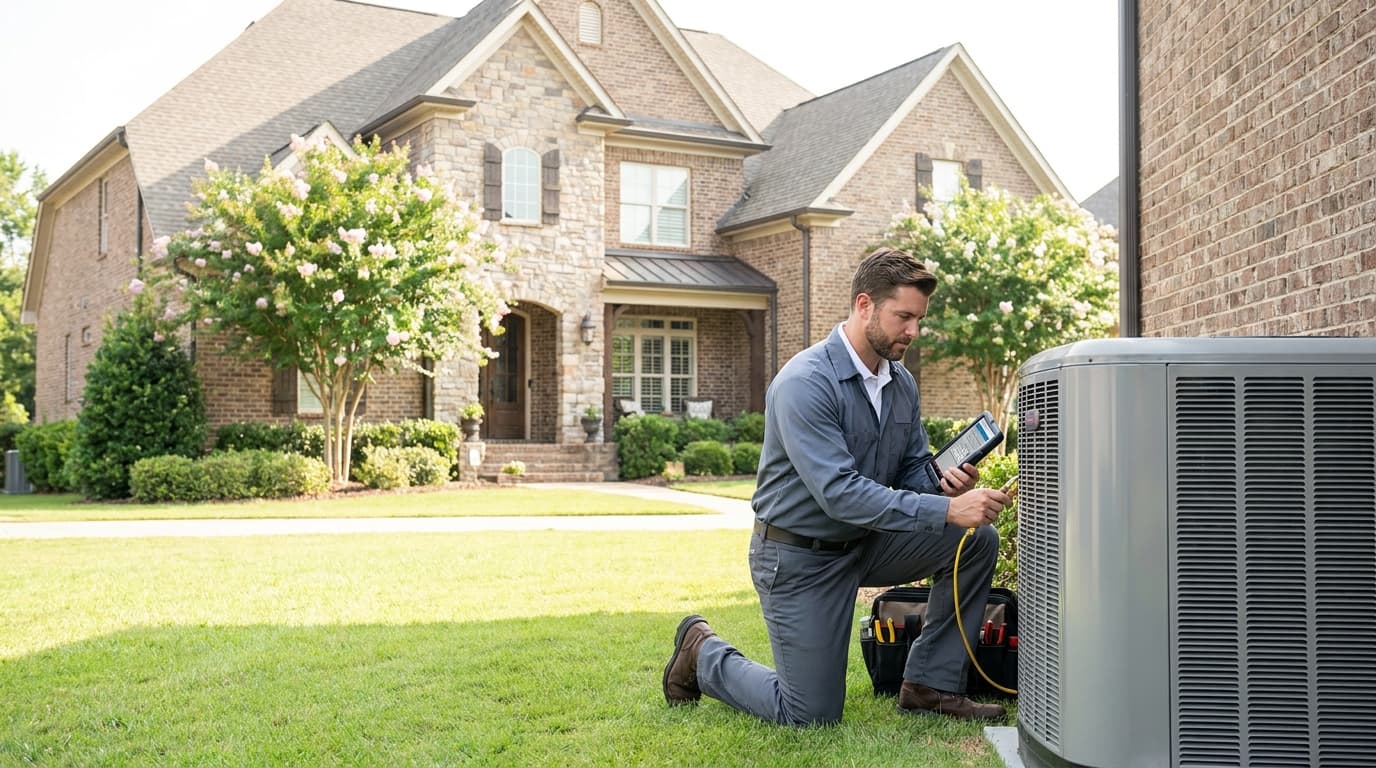
Seasonal HVAC Tune-Ups Built for North Metro Birmingham Homes
What a Real HVAC Tune-Up Includes
HVAC maintenance in Birmingham is what separates a system that lasts 20 years from one that dies at 10. Not the 15-minute drive-by that some companies call maintenance. A real tune-up. The kind that actually prevents breakdowns and extends the life of your equipment.
Here is exactly what our EPA Section 608 certified technicians do during a seasonal maintenance visit. Every step. No shortcuts.
| Scenario | Maintenance Approach | Neglect Approach |
|---|---|---|
| Capacitor | Caught at annual visit — low cost replacement | Fails mid-summer — emergency call, possible compressor stress |
| Dirty coils | Cleaned at tune-up — efficiency restored | ~5% efficiency loss per year (DOE), higher monthly bills |
| Refrigerant creep | Caught by superheat/subcooling check | Compressor overheats — high-cost repair or replacement |
| Condensate clog | Cleared at tune-up | Water damage to ceiling, walls, or flooring |
| System lifespan | 5–7 years longer (ACCA data) | Early failure — full replacement cost sooner |
| Source: U.S. Department of Energy and ACCA — HVAC Maintenance Standards | ||
Quick Reference Guide
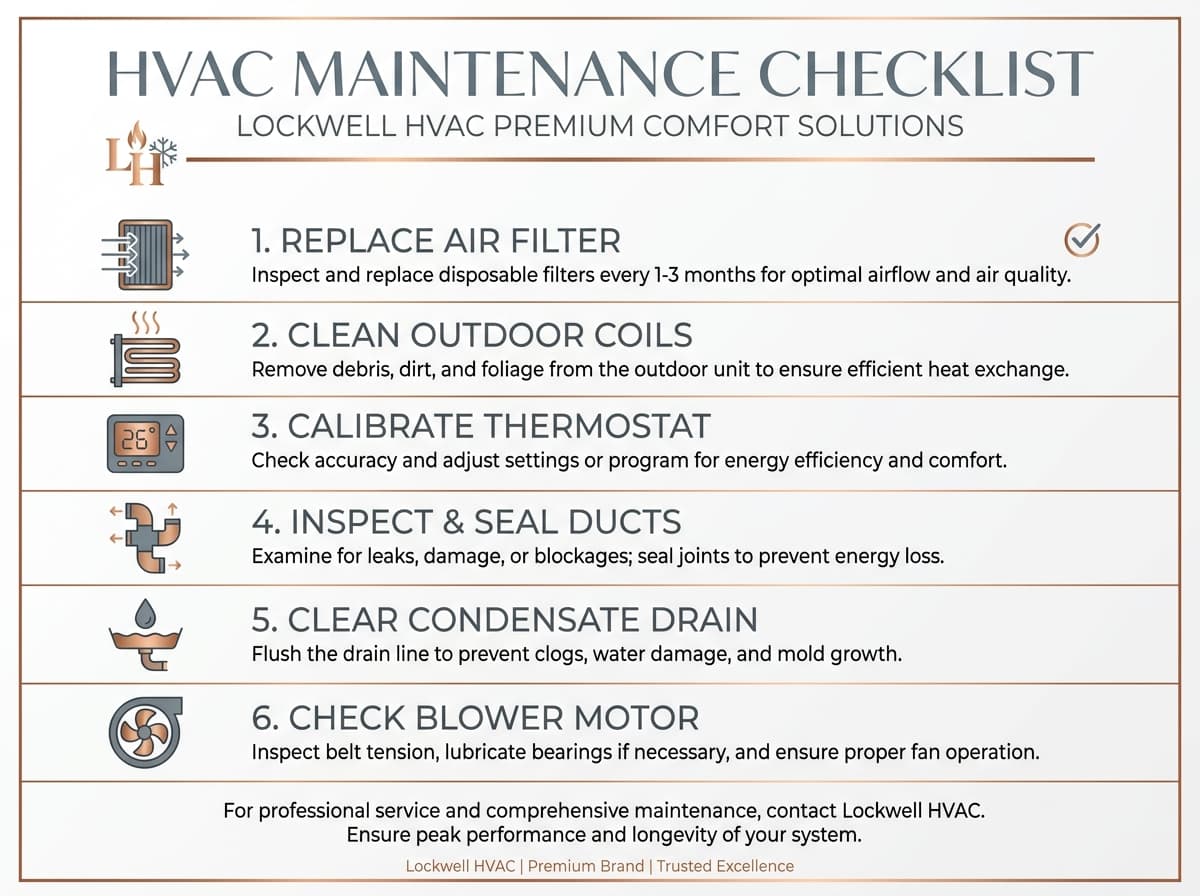
The Inspection — What We Check and Why
Evaporator coil cleaning. Your indoor coil collects dust, pollen, and biological growth every season. Alabama pollen loads — among the highest in the Southeast — coat these coils relentlessly. Dirty coils reduce heat transfer, force the system to work harder, and create conditions for mold growth. ASHRAE guidelines show that clean coils improve cooling efficiency by 10 to 15 percent. That is not a minor improvement. That is money you feel on every power bill.
Condenser coil cleaning. Your outdoor coil fights grass clippings, cottonwood fluff, pine pollen, and a year of airborne debris. The aluminum fins on the condenser coil are fragile — they bend easily and block airflow when clogged. We clean these coils carefully, straighten bent fins, and verify that the unit has proper clearance on all sides.
Refrigerant charge verification. We measure superheat and subcooling — the engineering parameters that confirm your system has the correct amount of refrigerant. Too little refrigerant means the system runs longer and the compressor works harder. Too much means excessive pressures that damage components. Either condition wastes energy and shortens equipment life.
Electrical connection tightening and testing. Every wire, terminal, and connection in the system gets checked. The NFPA identifies electrical failures as a leading cause of residential fires. HVAC systems cycle thousands of times per year, and each cycle produces vibration that gradually loosens connections. We tighten every terminal, check amp draws against manufacturer specs, and test capacitors for proper microfarad ratings.
Capacitor testing. Weak capacitors are ticking time bombs that fail on the hottest day of summer. A capacitor testing at 10 percent below its rated value is on borrowed time. We catch these before they fail and cause a cascading problem with your compressor or fan motor.
Motor lubrication. Fan motors and blower motors with oil ports get lubricated to reduce friction, heat, and wear. Not all motors have oil ports — newer sealed bearings are maintenance-free — but the ones that do require attention at least annually.
Thermostat calibration. We verify that your thermostat reads the correct temperature and that the system responds properly to temperature calls. A thermostat that reads 3 degrees low keeps your system running longer than necessary, wasting energy and increasing wear.
Condensate drain clearing. We flush the condensate drain line to prevent clogs that cause water damage. In Alabama humidity, your system removes gallons of water from indoor air daily. A clogged drain backs up that water into your ceiling, walls, or floor — damage that far exceeds the cost of annual maintenance.
The Math on Prevention vs. Emergency
A maintenance visit costs a fraction of what a single emergency repair costs. That is the simple math. But the real savings compound over years.
Systems that receive annual maintenance last 5 to 7 years longer than neglected ones, according to ACCA industry data. For equipment that costs thousands to replace, that is significant.
Maintained systems run at their rated efficiency every day. Neglected systems lose roughly 5 percent efficiency per year according to the Department of Energy. After three years of skipping maintenance, your 16-SEER system performs like a 13-SEER unit. You are paying for equipment performance you are not getting.
Most manufacturer warranties require documented annual professional maintenance. Skip it, and you void the warranty on components that cost thousands to replace. Compressors, heat exchangers, evaporator coils — all warranty-covered, all voided by neglect.
Twice a Year — Spring and Fall
Two comprehensive visits per year — spring before cooling season and fall before heating season. The timing is what matters: we catch problems before each peak demand period, not during it. A weak capacitor discovered in March is a five-minute fix. The same capacitor failing on a 95-degree July afternoon is a multi-hour emergency call with a sweat-drenched house and a dispatch queue.
Seasonal maintenance also catches the slow-moving problems that never look urgent in the moment — refrigerant creep, coil fouling, static pressure drift, contactor pitting — and gets them addressed before they cascade into a compressor replacement or a blower motor failure.
We assign the same technician to your home whenever possible. That technician learns your system, tracks its history across visits, and notices changes a first-time visitor would miss. Continuity of care matters as much for HVAC systems as it does for anything else.
Schedule Your Tune-Up
Call (205) 206-7030 to schedule a spring AC tune-up or fall heating tune-up. We serve Gardendale, Fultondale, Center Point, Irondale, Bessemer, Hueytown, Pleasant Grove, and Helena. Written estimates for any recommended repairs. Licensed and insured.
Maintenance — Frequently Asked Questions
Prepared by the field technicians at Lockwell HVAC in Gardendale, Alabama. This page reflects how we actually diagnose, repair, and install equipment on residential service calls across the North Birmingham metro — what we measure, what we replace, and how we verify the work before we leave.
Maintenance Service Area
Lockwell HVAC provides maintenance for homes in 9 North Birmingham metro communities. We do not service Hoover, Vestavia Hills, Mountain Brook, Trussville, or cities outside Jefferson and Shelby counties.
- [1]Clean coils improve cooling efficiency by 10 to 15 percent — ASHRAE (American Society of Heating, Refrigerating and Air-Conditioning Engineers)
- [2]5 percent efficiency loss per year without maintenance — U.S. Department of Energy
- [3]Maintained systems last 5 to 7 years longer — Air Conditioning Contractors of America (ACCA)
- [4]Electrical failures as a leading cause of residential fires — National Fire Protection Association (NFPA)
Bookmark this page for reference. Share it with a neighbor who might find it useful. If you have questions about anything covered here, call us directly — a real person answers, not a recording.