Variable-Speed Gas Furnace Installation for North Birmingham Homes
Why Premium Homes Pick Variable-Speed Over Single-Stage
A single-stage furnace knows two settings — on and off. It fires at full capacity until the thermostat is satisfied, then shuts down completely. The result on a mild Birmingham winter day is a system that runs hard for ten minutes, dumps a wave of hot air, then sits idle for forty-five minutes while the temperature drifts back down.
A variable-speed furnace runs continuously at the exact capacity the house needs at that moment. On a 28-degree January morning, it modulates up. On a 52-degree February afternoon, it idles down to 40 percent of rated capacity and runs quietly in the background. The thermostat does not see large swings. The rooms do not see drafts. The blower motor does not cycle through the loud startup-and-shutdown noise that single-speed equipment produces.
For homeowners renovating premium homes across the north metro Birmingham corridor, the difference is immediately noticeable. The system disappears into the background of how the house feels. That is the result every comfort upgrade should produce.
Quick Reference Guide
How a Variable-Speed System Actually Works
Two pieces make the difference — the gas valve and the blower motor.
The gas valve on a true modulating furnace adjusts firing rate from roughly 40 percent of maximum input up to 100 percent in continuous steps. The control board reads return-air temperature, supply-air temperature, and thermostat demand, then dials in the exact firing rate that maintains the setpoint. A two-stage furnace is a simpler version of the same idea — it picks between a low fire and a high fire rather than modulating continuously.
The blower motor is the second half of the equation. A standard PSC (permanent split capacitor) blower runs at one speed and one efficiency point. An ECM (electronically commutated motor) blower varies its speed continuously to match the firing rate of the furnace and the load on the duct system. ECM blowers also consume meaningfully less electricity than PSC blowers at part-load — which is most of the operating hours in Alabama's mild winter.
Together, the modulating gas valve and the ECM blower deliver heat the way a high-end audio system delivers sound — calibrated, continuous, and quiet. That is what owners are paying the premium for, and that is what a proper install must actually deliver.
Equipment We Specify on Premium Installs
Three manufacturers earn most of our variable-speed recommendations: Carrier, Trane, and Lennox. All three build true modulating furnaces with AFUE ratings above 96 percent and integrated communicating control platforms.
Carrier Infinity 98 modulating series pairs with the Infinity touchscreen control for full system communication. The furnace, the matched outdoor unit, and the thermostat all share data — the system knows what the other components are doing and adjusts accordingly. Trane XV95 and XV97 modulating series do the same with the ComfortLink II platform. Lennox SLP99V is the efficiency leader at 99 percent AFUE and pairs with the iComfort thermostat.
We install matched systems. Putting a Carrier Infinity furnace under a discount outdoor unit defeats the entire purpose of the communicating platform. When a homeowner is investing in premium heating equipment, the install includes the matched air conditioner or heat pump, the matched thermostat, and the manufacturer-registered warranty on every component.
Combustion Analysis on Every Install
A variable-speed furnace is a precision-tuned combustion appliance. The gas pressure, the inducer fan speed, the supply-air temperature rise, and the combustion gas composition all have to fall inside the manufacturer-published spec window. A furnace that fires outside spec produces excess carbon monoxide, soot the heat exchanger, and shorten the equipment lifespan.
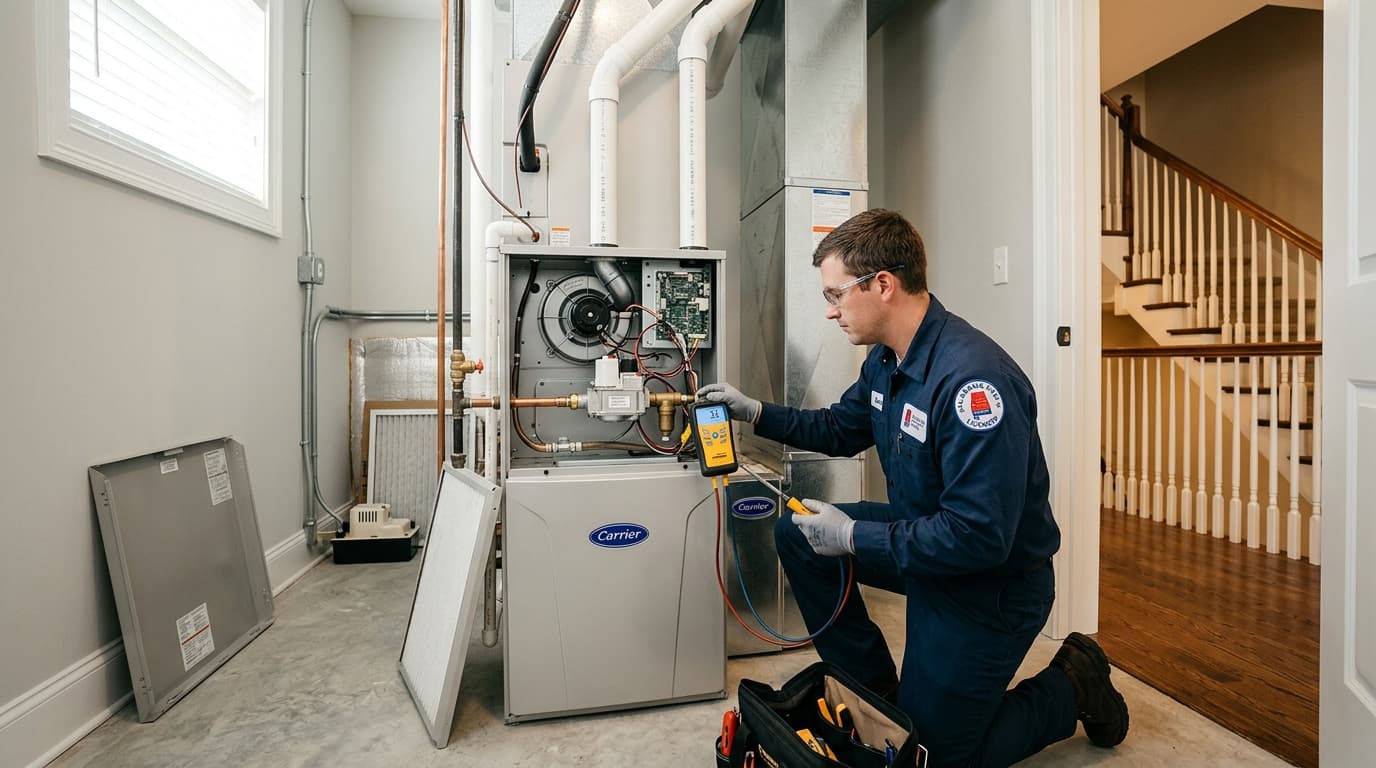
Our installers run a combustion analyzer on every install before they leave the property. We measure CO in parts per million at the flue, oxygen percentage in the exhaust, stack temperature, and excess air. Numbers go on the commissioning sheet that lives with the equipment. If anything reads outside spec, we adjust before the system is signed off.
This is not optional work on a premium install. The whole point of the equipment investment is precision, and combustion analysis is how precision gets verified. Most contractors skip the step. We do not.
Ductwork Has To Match the Equipment
A variable-speed furnace at low fire moves much less air than a single-stage furnace at high fire. Duct systems sized for the old equipment can produce comfort problems with the new equipment if the static pressure is wrong.
We test duct static pressure at the air handler before quoting any furnace replacement. A manometer reads supply-side and return-side pressure during operation, and the result tells us whether the existing ducts will support the new system or whether modifications are needed. Bad ducts under a premium furnace waste the customer's investment, and we will not install a system that we know will underperform because of duct problems.
When ductwork needs modification, we quote it in writing alongside the equipment. Adding a second return, replacing crushed flex duct, sealing supply trunks, or reconfiguring takeoffs — whatever the duct system actually needs to deliver the rated airflow at the right static pressure. The customer decides what they want to address.
Permits, Inspections, and Manufacturer Registration
Every furnace install in Mountain Brook, Vestavia Hills, Homewood, and across the City of Birmingham requires a mechanical permit. We pull it, schedule the inspection, and deliver the close-out paperwork to the homeowner. That is part of the install — not an extra charge and not optional.
Manufacturer registration is the second piece of post-install paperwork that matters. Carrier, Trane, and Lennox all require registration within 30 to 60 days of installation to activate the full parts-and-labor warranty. We register the equipment the day we leave and provide the registration confirmation to the homeowner in writing. Failing to register a premium furnace can downgrade the warranty from 10 years to 5 years on a system that costs thousands of dollars.
What Variable-Speed Will and Will Not Do
It will deliver noticeably more even comfort across the house. It will run quieter than single-stage equipment. It will use less electricity at the blower because of the ECM motor. It will dehumidify better at part-load because the blower can run at lower speeds during cooling-season operation.
It will not pay back the price premium in fuel savings alone over a single-stage 96-percent unit. The honest math says the operating-cost difference between a 96 AFUE single-stage and a 96-99 AFUE modulating furnace is modest — a couple hundred dollars per year on a typical Alabama winter. The reason to spend the premium is comfort, quiet, humidity control, and equipment longevity. Not fuel savings.
It will not fix problems caused by bad ducts, bad insulation, or an oversized cooling system. A variable-speed furnace is a precision tool — it works best in a house where the other comfort fundamentals are already addressed.
Why Homeowners Pick Lockwell for Premium Furnace Installs
We install premium residential HVAC equipment across the north metro Birmingham corridor for owners who want the work done correctly. That means Manual J before the equipment is selected. Static pressure measurement before the install. Combustion analysis after the install. Manufacturer registration the day we leave. Permit handling through the local jurisdiction.
Every Lockwell technician is EPA Section 608 certified, working under the Alabama HVAC contractor license of John M. King (#2020068). Gas-fired equipment work is performed by technicians trained in combustion analysis and gas-piping diagnostics. We are insured for liability and workers compensation on every job.
Call (205) 206-7030 to schedule a furnace assessment. We walk the house, measure the ductwork, calculate the load, and quote the system in writing before any equipment is ordered.
Variable-Speed Furnace Installation — Frequently Asked Questions
Prepared by the field technicians at Lockwell HVAC in Gardendale, Alabama. This page reflects how we actually diagnose, repair, and install equipment on residential service calls across the North Birmingham metro — what we measure, what we replace, and how we verify the work before we leave.
Variable-Speed Furnace Installation Service Area
Lockwell HVAC provides variable-speed furnace installation for homes in 9 North Birmingham metro communities. We do not service Hoover, Vestavia Hills, Mountain Brook, Trussville, or cities outside Jefferson and Shelby counties.
- [1]AFUE rating standards and combustion efficiency for residential gas furnaces — U.S. Department of Energy — Furnaces and Boilers (energy.gov)
- [2]ACCA Manual J load calculation standards for residential HVAC sizing — Air Conditioning Contractors of America (ACCA)
- [3]Carrier Infinity 98 modulating furnace specifications — Carrier Corporation (carrier.com)
- [4]Trane XV95 and XV97 variable-speed furnace specifications — Trane Technologies (trane.com)
- [5]Lennox SLP99V variable-capacity gas furnace specifications — Lennox International (lennox.com)
- [6]NFPA 54 National Fuel Gas Code requirements for residential gas appliance installation — National Fire Protection Association
Bookmark this page for reference. Share it with a neighbor who might find it useful. If you have questions about anything covered here, call us directly — a real person answers, not a recording.