What's Wrong With My Air Conditioner — Common Failures Explained
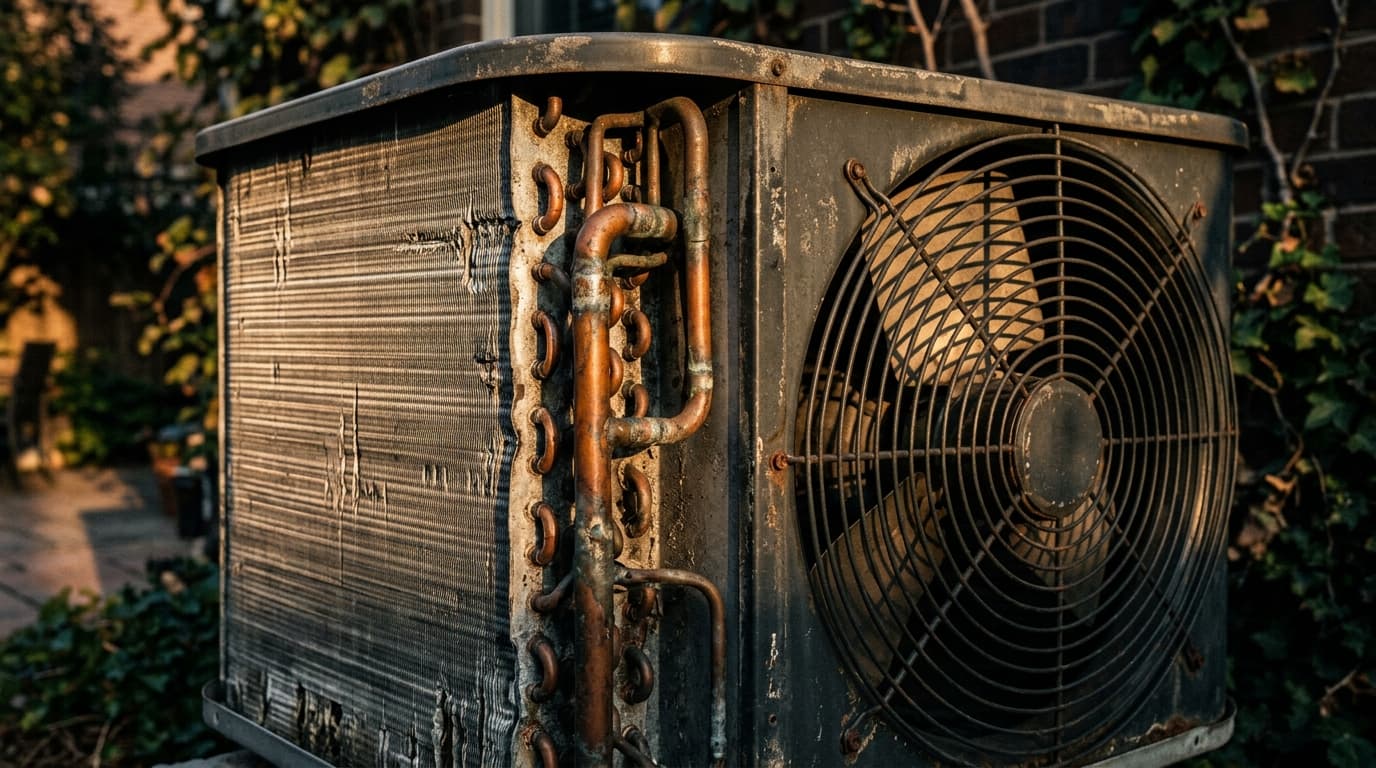
Start with the basics before calling: check the thermostat settings, replace the air filter, clear the condensate drain, and verify the outdoor unit is running. If none of those fix it, you're likely looking at a refrigerant leak, capacitor failure, or compressor problem — all of which need a licensed technician with proper diagnostic equipment.
Start Here Before You Call Anyone
Most AC service calls in Birmingham fall into a short list of causes. Before spending money on a service call, check these yourself — they're free and fix a meaningful percentage of problems.
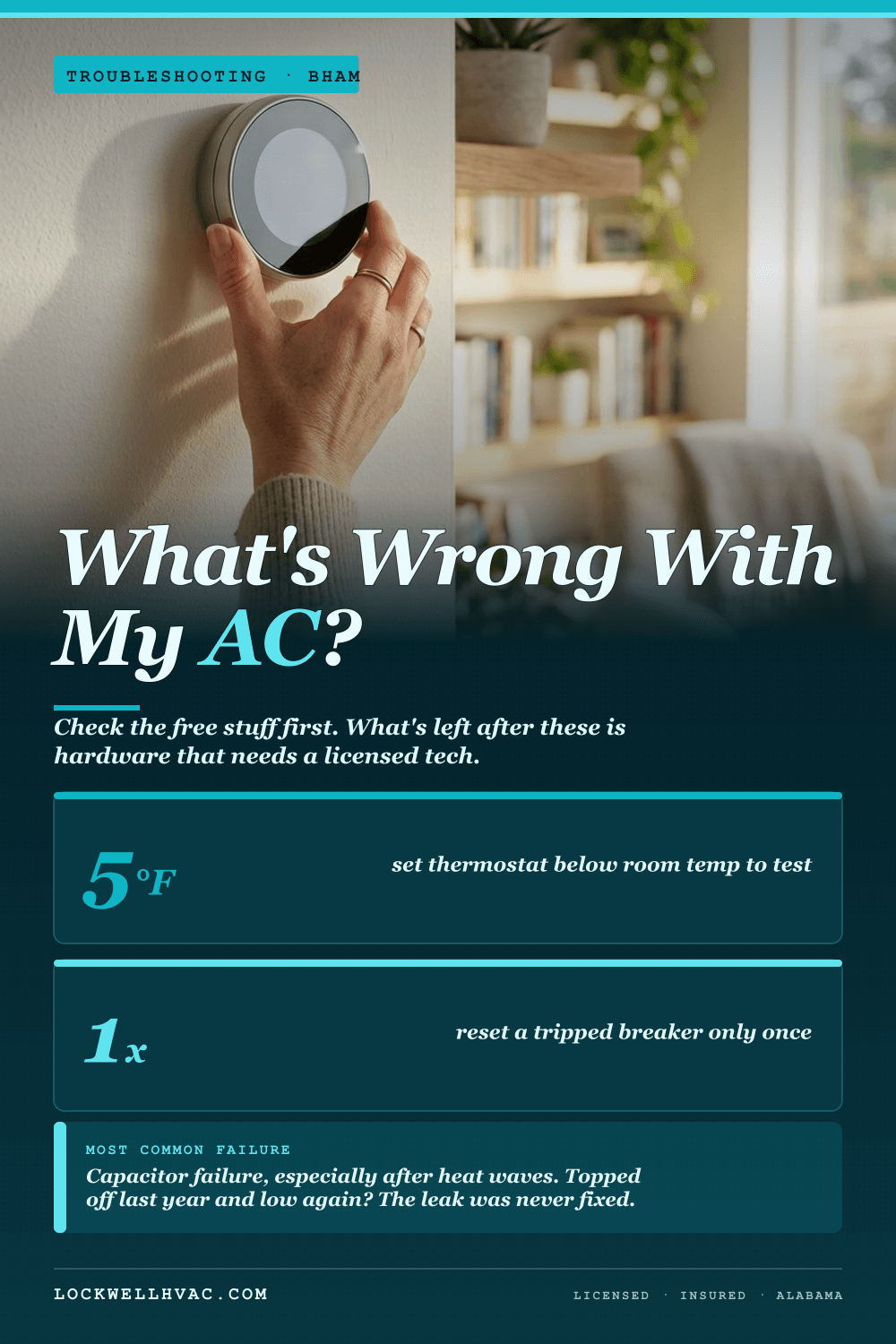
**Thermostat set correctly?** Switch to COOL mode, set 5 degrees below room temperature, confirm the fan is on AUTO not ON. Fan set to ON blows uncooled air continuously and makes the house feel warm even when the system is running.
**Air filter clogged?** A plugged filter restricts airflow across the evaporator coil. Restricted airflow causes the coil to freeze, which blocks airflow further. Turn the system off, replace the filter, switch to fan-only to melt any ice (takes 30 to 60 minutes), then restart in cooling mode. If the coil keeps icing back over, walk through our deeper guide on AC freezing up causes and fixes in Alabama.
**Outdoor unit running?** Walk outside. Is the fan spinning? Is the compressor making any sound? A unit that doesn't run at all typically has an electrical problem — tripped breaker, blown fuse at the disconnect, or failed capacitor.
**Breaker tripped?** Check your electrical panel. HVAC equipment often has two breakers — one for the air handler, one for the outdoor unit. Reset a tripped breaker once. If it trips again immediately, stop — there's a fault that needs diagnosis.
**Condensate drain backed up?** Your indoor unit has a drain pan under the evaporator coil. If the condensate drain is clogged, the pan fills with water. Most systems have a float switch that shuts the unit down when the pan fills to prevent water damage. If your system turns on then shuts off quickly, check the drain pan for standing water.
Capacitor Failure — The Most Common Repair in Alabama
A capacitor is a cylindrical component that stores electrical charge and gives your compressor and fan motors the starting torque they need. Alabama heat degrades capacitors faster than their rated lifespan suggests. Extended periods above 95°F are brutal on these components.
**Symptoms of a failed or failing capacitor:** - Outdoor unit hums but doesn't start - Fan blade moves slowly or not at all when the system tries to start - System starts but shuts off within seconds - Loud click or hum from the outdoor unit at startup
A failed run capacitor is one of the most straightforward repairs an HVAC technician makes. The part costs relatively little, replacement takes minutes, and a fully stocked truck carries capacitors for every major brand.
What makes capacitor failure costly when ignored: every failed start attempt stresses your compressor. The compressor tries to pull locked-rotor amperage through a motor that doesn't have proper starting torque. Do this enough times and you turn a small capacitor repair into a compressor replacement.
Capacitor failure, particularly after extended heat waves that push components past their rated operating temperatures
Refrigerant Leak — Not a Top-Off Situation
Your AC system runs on a closed refrigerant loop. It does not consume refrigerant the way a car burns gasoline. If the refrigerant level is low, you have a leak somewhere in the system.
Adding refrigerant without finding and fixing the leak is a waste of money. The charge will drop again — weeks or months later — and you'll be back where you started, plus you've added to your running costs and may have allowed the low-charge condition to stress the compressor.
**Symptoms of low refrigerant:** - System runs continuously but can't cool the house to setpoint - Ice forming on the refrigerant lines or the indoor coil - Warm air from supply registers even when the system is running hard - Higher-than-normal electric bills because the system runs longer
Per U.S. EPA regulations, refrigerant must be handled by EPA Section 608-certified technicians. Leaks must be repaired before refrigerant is added on systems over a certain charge size. This isn't optional or negotiable.
A technician finds the leak using electronic detection, fluorescent dye, or nitrogen pressure testing. Common leak locations: evaporator coil (corrosion-related, especially in homes with formaldehyde-emitting materials), schrader valve cores, flare connections at the service valves, and the line set where it passes through walls.
If your system was "topped off" with refrigerant last season and is struggling to cool again this year, the leak was never fixed. Insist on leak detection before accepting another refrigerant charge.
Frozen Evaporator Coil — What It Means and What to Do
Ice on your indoor coil or refrigerant lines is never normal during summer operation. It indicates one of two problems: restricted airflow or low refrigerant.
**Restricted airflow (dirty filter is the most common cause):** The evaporator coil operates below the dew point to remove humidity from the air. When airflow is restricted, the coil temperature drops below freezing and moisture in the air freezes on the coil surface. Ice accumulates, blocks more airflow, and the problem cascades until the system shuts down.
Fix: turn the system off, let it defrost (switch to fan-only to speed this up), replace the filter, and restart. If the coil freezes again with a clean filter, you have a different problem.
**Low refrigerant:** Less refrigerant in the system means lower suction pressure, which means lower coil temperature, which means the coil runs below freezing even with adequate airflow. This is a leak problem and needs professional diagnosis.
Do not continue running a system with a frozen coil. You can damage the compressor by sending liquid refrigerant back through the suction line — a condition called liquid slugging that causes catastrophic mechanical failure.
Compressor Problems — The Expensive Diagnosis
The compressor is the heart of your cooling system. It pumps refrigerant through the entire circuit. When it fails completely, you typically face a major repair or full system replacement decision.
**Symptoms of a failing or failed compressor:** - System runs but produces no cooling — outdoor unit running, indoor unit blowing, but no temperature change - Loud grinding, banging, or rattling from the outdoor unit - Compressor attempts to start and immediately trips a breaker or shuts off on thermal protection - Compressor runs in short cycles — starts and stops repeatedly within minutes
What kills compressors before their time? Running on incorrect refrigerant charge (low charge causes high compression ratios and heat buildup). Dirty coils raising operating pressures. Weak capacitors causing hard starts repeatedly. These are all conditions caught during annual maintenance.
When a compressor fails, a technician needs to assess whether replacement makes sense. On a system under warranty or less than 8 years old, compressor replacement may be the right call. On a 12+ year old system approaching end of life, replacing just the compressor is often poor value.
Contactor Failure — The Part Nobody Talks About
The contactor is an electromechanical switch in the outdoor unit that connects and disconnects the compressor and fan from line voltage. It takes a high-voltage electrical arc every time the system starts. Over time, the contacts pit, corrode, and eventually fail to make proper contact.
**Symptoms of a failing contactor:** - System doesn't respond when the thermostat calls for cooling — no outdoor unit startup at all - Intermittent cooling — works for a while, stops, starts again later - Pitted or burned contacts visible during inspection (requires opening the outdoor unit) - Small lizards or insects bridging the contacts (common in Alabama — seriously)
Contactor replacement is inexpensive and straightforward. A technician spots it during any diagnostic visit.
Duct Leakage — Losing Conditioned Air Before It Reaches You
Your ducts distribute cooled air through the house. If they leak — at connections, at boots where ducts attach to registers, or where flex duct has pulled apart — you're cooling your attic instead of your living room.
Per ACCA Manual S standards, duct leakage above 10-15% of system airflow is a significant performance problem. Many older Birmingham homes have duct leakage well above that threshold, especially systems with flex duct in hot attics.
Signs of duct leakage: one room that's always hotter than others, high electric bills despite normal thermostat setpoints, supply registers that barely move when the system runs at full speed.
This is diagnosable with a duct blaster test and fixable with Aeroseal or manual mastic sealing on accessible ductwork.
Need HVAC service in the Birmingham area?
Available 24/7. Licensed and insured. Written estimates before work begins.
Call (205) 206-7030Frequently Asked Questions
Visual Guide
Compiled by the HVAC technicians at Lockwell HVAC in Gardendale, Alabama. The troubleshooting steps here are the same ones we walk through on residential service calls across North Birmingham, written so a homeowner can rule out the simple causes before deciding whether a system needs a technician.
- U.S. Department of Energy — Energy efficiency and maintenance guidelines
- ENERGY STAR — Thermostat and installation efficiency standards
- ASHRAE — Coil cleaning and maintenance guidelines
- ACCA — Manual J load calculation standards and equipment lifespan data
- U.S. EPA — Refrigerant regulations and indoor air quality guidance
- NFPA — Electrical safety and fire prevention
- CPSC — Carbon monoxide safety data
- NADCA — Duct cleaning standards
Bookmark this page for reference. Share it with a neighbor who might find it useful. If you have questions about anything covered here, call us directly — a real person answers, not a recording.
Read Next