SEER Ratings Explained for Birmingham AL
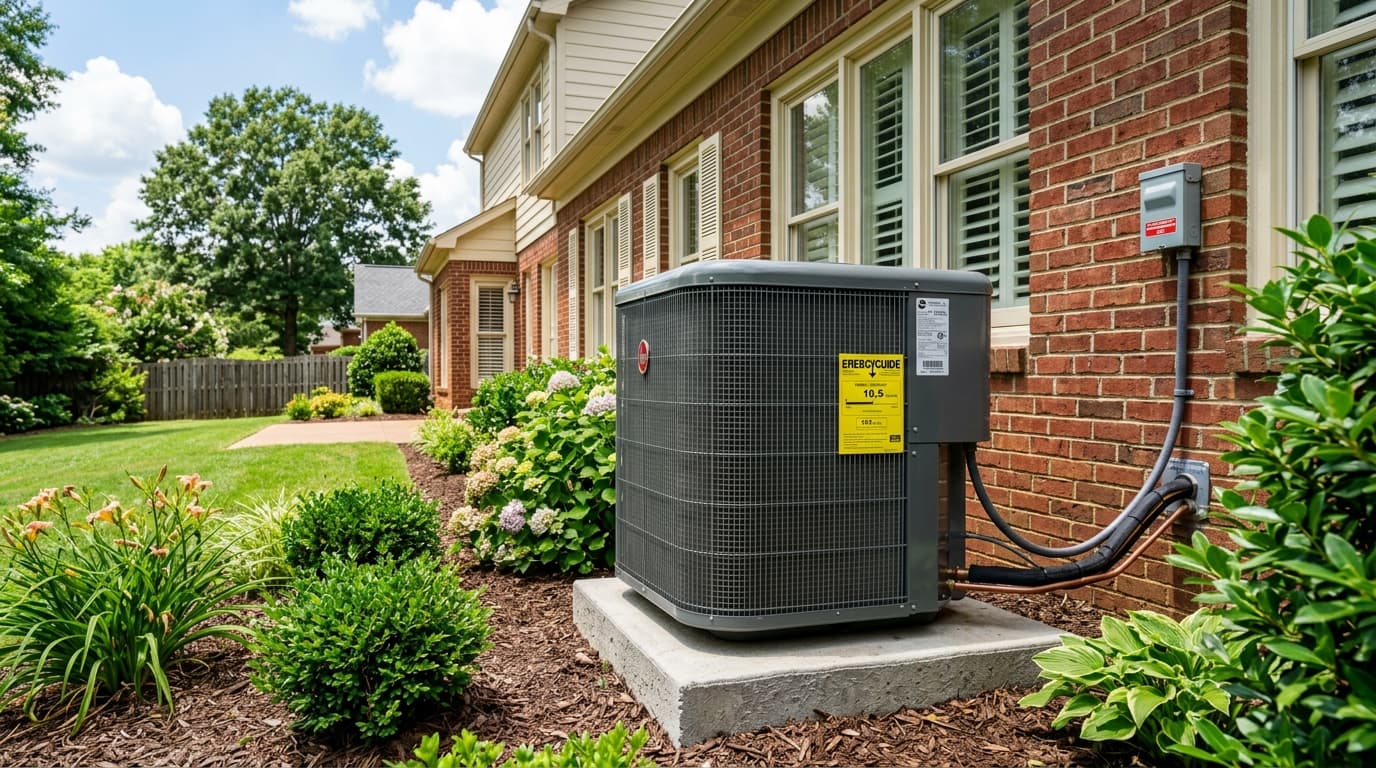
SEER measures AC efficiency — higher is better. Alabama requires minimum SEER 15 for new installations. For Birmingham's 6-month cooling season, SEER 16-18 is the sweet spot where efficiency gains still pay back within a reasonable timeframe.
What SEER Rating Means in Plain English
SEER rating explained simply: it measures how efficiently your air conditioner converts electricity into cooling. SEER stands for Seasonal Energy Efficiency Ratio. The number tells you how many BTUs of cooling you get per watt-hour of electricity consumed, averaged across a full cooling season.
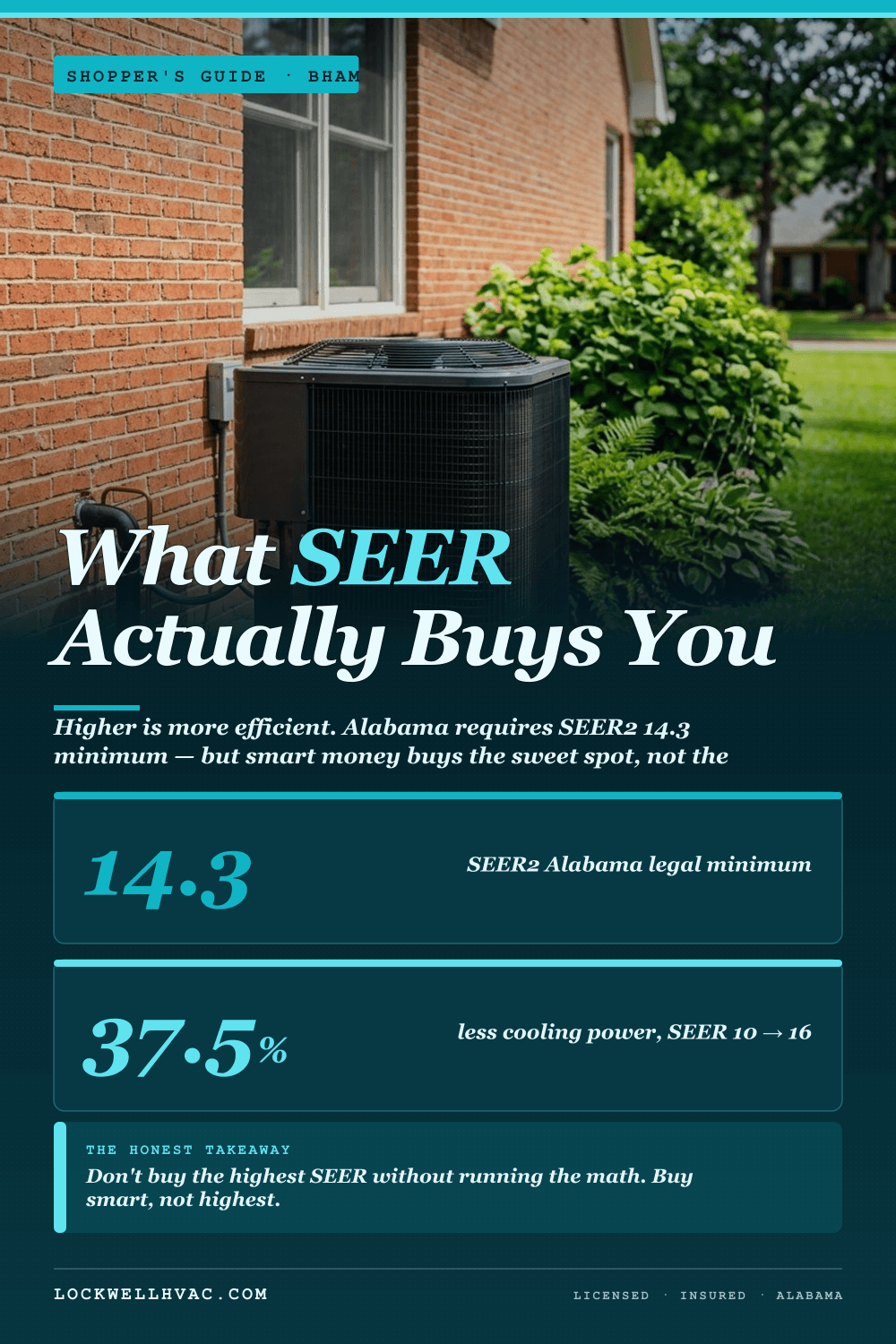
A SEER 16 unit produces 16 BTUs of cooling per watt-hour of electricity. A SEER 10 unit produces 10. The SEER 16 system does the same cooling job for 37.5 percent less electricity. That difference in operating cost is real money every month your system runs. If your bill keeps climbing despite a working system, our breakdown of why your electric bill is so high in summer Alabama shows exactly where the dollars go.
Here is the practical version: take your current monthly cooling bill during peak summer. Divide by the SEER of your current system. Multiply by the SEER of the new system. That gives you an approximation of what the new system would cost to run under the same conditions.
Reduction in cooling electricity consumption when upgrading from SEER 10 to SEER 16 — calculated directly from the ratio
SEER vs. SEER2 — The Update That Changed the Numbers
Starting in 2023, the industry shifted from SEER to SEER2 ratings. SEER2 uses a more rigorous test standard with higher external static pressure — conditions that better reflect real-world duct systems. The result: SEER2 numbers look lower than old SEER numbers for the same equipment.
A system rated SEER 16 under the old standard might rate SEER2 15.2 under the new one. It is the same equipment performing the same. The test changed, not the hardware.
When you are comparing equipment, make sure you are comparing the same rating standard. Mixing old SEER and new SEER2 ratings creates apples-to-oranges comparisons. Ask your contractor which standard each unit's rating reflects.
The Alabama minimum of SEER2 14.3 (equivalent to old SEER 15) applies to all new residential AC installations as of 2023. Equipment sold in Alabama must meet or exceed this threshold.
What Minimum SEER Means and Why You Should Buy Higher
Alabama's minimum SEER2 14.3 / SEER 15 requirement exists because it is the point where efficiency delivers measurable energy savings over older systems. But minimum is not optimal.
Here is the honest assessment of where different SEER levels make sense for Birmingham homeowners:
SEER 15-16: Meets minimum requirements. Meaningful improvement over older 10-13 SEER systems. Appropriate when budget is the primary constraint.
SEER 16-18: The sweet spot for most Birmingham homes. Efficiency gains are real and the payback period is reasonable — typically 4 to 7 years through energy savings depending on your current system's rating and your usage.
SEER 18-20: Good choice for larger homes with higher cooling costs where the incremental efficiency improvement justifies the higher equipment cost.
Above SEER 20: Diminishing returns territory. The equipment cost premium for marginal efficiency gains above 20 SEER makes sense for very specific situations — extremely high cooling loads, utility rebate programs that reduce equipment cost, or homeowners who run their systems very aggressively.
Do not buy the highest SEER rating without running the math. A SEER 21 unit costs thousands more than a SEER 17. In a typical Birmingham home, the energy savings difference between SEER 17 and SEER 21 might take 15 or more years to recover the price premium. Buy smart, not highest.
How Birmingham's 6-Month Cooling Season Changes the Math
Here is why SEER efficiency matters more in Birmingham than in most of the country: we run air conditioning for roughly six months. April through October sees meaningful cooling loads. Compare that to a Northern city that might run AC for 3 months.
Same SEER improvement, but Birmingham homeowners accumulate twice the runtime. That means twice the annual savings. That means the payback period on a higher SEER system is cut roughly in half compared to a cooler climate.
A Birmingham homeowner upgrading from SEER 10 to SEER 16 might recover the efficiency investment through energy savings in 4 to 6 years. The same upgrade in Chicago might take 8 to 10 years. Same equipment, same math, different climate.
This is why the Southeast region has higher minimum SEER requirements than the North. The Department of Energy set regional standards specifically because cooling load determines how quickly efficiency gains pay back.
Approximate cooling season length in Birmingham AL — roughly double that of Northern U.S. cities, which accelerates payback on higher-SEER equipment investments
How to Calculate Your Potential Savings
You can estimate your efficiency savings with a simple calculation:
1. Find your current system's SEER rating (it is on the yellow EnergyGuide label on the outdoor unit, or on the model number plate) 2. Find your average monthly electric bill during peak cooling months (June-August) 3. Estimate what percentage of that bill is cooling (typically 50-70% in Birmingham during summer) 4. Divide your current cooling cost by your current SEER, then multiply by the new SEER
Example: Your bill during peak cooling months (June–August) is your starting point. Multiply it by 60% to estimate the cooling portion. Then divide by your current SEER and multiply by the new SEER. A home on a typical Birmingham summer bill spending $150 on cooling with a SEER 10 system would estimate: $150 × (10/16) = $93.75 cooling cost with the new unit. Monthly savings: $56.25. Annual savings over a 6-month season: roughly $337. (Source: U.S. Department of Energy efficiency formula; actual results vary by home size, insulation, and usage.)
That math is simplified — real-world results vary based on home insulation, thermostat settings, and equipment sizing. But it gives you a reasonable ballpark for evaluating the investment.
SEER and Variable-Speed Systems
The highest SEER ratings almost always come paired with variable-speed compressors and variable-speed air handlers. These systems modulate their output — running at lower capacity during mild conditions and ramping up during peak demand — rather than cycling on and off at full power.
Variable-speed systems deliver better dehumidification, quieter operation, more even temperatures, and longer compressor life alongside their high efficiency ratings. In Birmingham's humid climate, the dehumidification advantage is not trivial. A system running at 60% capacity for two hours removes more moisture than a system running at 100% for one hour.
If your budget allows for SEER 18 or above, you are almost certainly getting a variable-speed system. That package of features — efficiency, humidity control, and comfort — often justifies the premium in Birmingham conditions.
Need HVAC service in the Birmingham area?
Available 24/7. Licensed and insured. Written estimates before work begins.
Call (205) 206-7030Frequently Asked Questions
Visual Guide
Compiled by the HVAC technicians at Lockwell HVAC in Gardendale, Alabama. The comparisons and explanations here are grounded in what we install and service every week across the North Birmingham metro, so the trade-offs reflect how systems hold up in Alabama homes rather than spec-sheet claims.
- U.S. Department of Energy — Energy efficiency and maintenance guidelines
- ENERGY STAR — Thermostat and installation efficiency standards
- ASHRAE — Coil cleaning and maintenance guidelines
- ACCA — Manual J load calculation standards and equipment lifespan data
- U.S. EPA — Refrigerant regulations and indoor air quality guidance
- NFPA — Electrical safety and fire prevention
- CPSC — Carbon monoxide safety data
- NADCA — Duct cleaning standards
Bookmark this page for reference. Share it with a neighbor who might find it useful. If you have questions about anything covered here, call us directly — a real person answers, not a recording.
Read Next