HVAC Companies in Birmingham AL — What to Evaluate Before You Hire

Verify the Alabama HVAC contractor license number on the state HACR board site, confirm EPA Section 608 certification before any refrigerant work, require written estimates before work begins, and ask specifically whether a Manual J load calculation is included in any replacement quote. These four steps filter out the contractors most likely to cost you money through poor workmanship or dishonest pricing.
Why Contractor Selection Matters More Than Brand Selection
Most homeowners approaching an HVAC replacement or major repair focus on the equipment brand. Trane versus Carrier. Lennox versus Rheem. This is the wrong question to optimize first.
A mid-grade system installed correctly by a skilled technician outperforms a premium system installed by a contractor who skips the load calculation and doesn't verify refrigerant charge at startup. The installation quality drives long-term performance. The equipment brand is secondary.
This matters in Birmingham specifically because the market includes contractors at every quality level. Alabama's construction boom and shortage of skilled trades has put pressure on service quality across the industry. Knowing what to verify before hiring protects you.
Verify Alabama HVAC Contractor Licensing
In Alabama, HVAC contractors are licensed through two pathways depending on the scope of work:
**Alabama Mechanical License** through the Alabama Electrical Contractors Board covers heating, ventilation, and air conditioning work. You can verify a contractor's license at aecb.alabama.gov.
**Alabama General Contractor License** covers some HVAC work when bundled with broader construction projects.
A contractor performing HVAC work in Alabama without a proper license is operating illegally. This matters not just for compliance — unlicensed work may void your homeowner's insurance coverage for claims arising from that work.
Ask for the license number and verify it before signing any agreement. A legitimate contractor will provide this without hesitation.
Verify the License and EPA Section 608 Certification
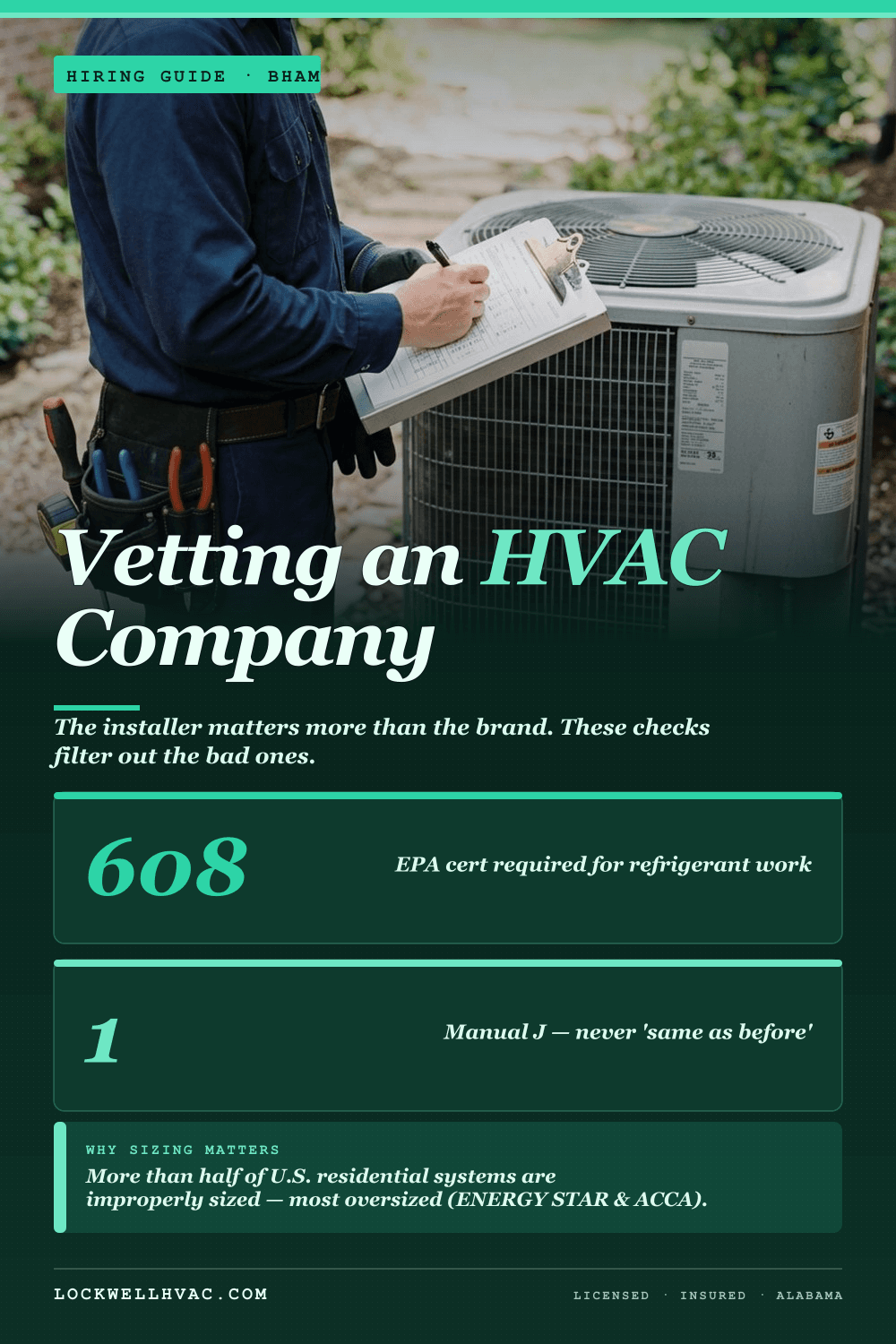
Before you trust anyone with your system, confirm the two credentials that actually carry legal weight. First, the Alabama HVAC contractor license — get the number and verify it on the Alabama HACR board site. A legitimate contractor hands over the license number without hesitation.
Second, EPA Section 608 certification. This is the federal credential required by law to purchase, recover, and handle refrigerant. A tech without it cannot legally touch the refrigerant in your system.
When getting quotes, ask specifically: "What is your Alabama contractor license number, and are your techs EPA Section 608 certified?" Both answers should be verifiable on the spot. A contractor who dodges either question is the one to avoid.
Ask for Written Estimates Before Any Work
A written estimate before work begins is not a courtesy — it's protection. Without it, you have no documentation of what was quoted, no basis for a price dispute, and no record of what the technician said was wrong.
A proper written estimate for a repair includes: - The specific problem diagnosed - The specific part(s) being replaced - Labor time and rate - Parts cost - Total price
A proper written estimate for a replacement includes: - Equipment model numbers for both indoor and outdoor units - The matched AHRI certificate for the system pair - Load calculation results (see below) - Installation scope (what is and isn't included — pad, lineset, electrical, etc.) - Warranty terms — equipment warranty and labor warranty separately
Any contractor who provides a verbal quote and resists putting it in writing is a contractor to avoid.
Demand a Manual J Load Calculation for Replacements
If you're replacing your HVAC system and the contractor doesn't mention a Manual J load calculation, ask for it explicitly. If they don't know what it is, find a different contractor.
A Manual J load calculation is the engineering analysis that determines what size system your home actually needs — accounting for square footage, insulation levels, window area and orientation, infiltration rate, internal heat gain, and local climate data.
Per ACCA standards, Manual J is the industry standard for residential load calculation. A system sized correctly through Manual J provides better comfort, better humidity control, and longer equipment life than an oversized or undersized system installed by rule-of-thumb.
The most common shortcut contractors take: they size the new system to match what was there before. If the previous system was oversized (which is common in Birmingham homes where older systems were routinely oversized), this just perpetuates the problem. If you're trying to figure out whether the old box is even worth replacing yet, our guide to how long HVAC systems last in Alabama gives realistic numbers by equipment type.
More than half of residential HVAC systems in the United States are improperly sized — most are oversized, which causes short-cycling, poor humidity removal, and premature equipment wear
Red Flags in HVAC Quotes
**No written estimate.** Covered above. Walk away.
**"The same size you had before."** Without a Manual J, this is a guess.
**Pressure to decide immediately.** Legitimate contractors give you time to compare quotes. Pressure tactics signal either over-priced work or work you don't need.
**Refrigerant top-off without leak detection.** If a technician offers to "add some refrigerant" without looking for the leak first, they're setting you up for a repeat service call. The refrigerant will be low again in 6 to 12 months.
**Large whole-house duct cleaning upsell on every visit.** Annual duct cleaning is unnecessary for most homes. If every maintenance visit generates a duct cleaning recommendation, the technician is working from a commission script, not from a genuine assessment of your ductwork.
**No startup sheet after installation.** A properly installed system should be commissioned at startup — refrigerant charge verified by superheat and subcooling measurement, airflow measured, static pressure recorded, and all electrical values documented. If the installer doesn't leave a startup commissioning sheet, the system was not properly commissioned.
Comparing Multiple Quotes Intelligently
Get at least two quotes, ideally three, for any replacement or significant repair. When comparing:
**Compare system efficiency ratings.** SEER2 is the current efficiency metric. A 16 SEER2 system is meaningfully more efficient than a 14 SEER2 over a Birmingham cooling season. Higher SEER2 costs more upfront and saves on operating cost over time.
**Compare warranty terms.** Most major brands offer 5 to 10 year parts warranties on registered systems. Ask whether the contractor handles warranty registration, and ask about their labor warranty — typically 1 to 2 years on installation workmanship.
**Check if AHRI certification is included.** The matched AHRI certificate documents the efficiency rating of the specific indoor/outdoor unit combination being installed. This is required for many ENERGY STAR rebates and for warranty verification.
**Verify what's included in the installation price.** Some quotes include a new pad, new lineset, new electrical disconnect, and line-set insulation as standard. Others quote equipment only and add these as line items. Compare total installed cost, not just equipment cost.
How to Check HVAC Company Reviews
Online reviews provide useful signal, but with caveats. Prioritize:
**BBB (Better Business Bureau):** al.bbb.org — shows complaint history and resolution patterns, not just ratings.
**Alabama Board of HACR licensing:** Verify the license is current and has no disciplinary actions. A contractor with a history of complaints to the licensing board is a meaningful red flag.
**Google Business reviews:** Useful for volume of feedback. Look for patterns in negative reviews — are complaints about pricing disputes, incomplete work, or equipment failures within warranty? These patterns matter more than individual reviews.
Avoid making hiring decisions based primarily on heavily discounted offers or "limited time" promotions. These are common upsell drivers in the HVAC industry.
Need HVAC service in the Birmingham area?
Available 24/7. Licensed and insured. Written estimates before work begins.
Call (205) 206-7030Frequently Asked Questions
Visual Guide
Compiled by the HVAC technicians at Lockwell HVAC in Gardendale, Alabama. The comparisons and explanations here are grounded in what we install and service every week across the North Birmingham metro, so the trade-offs reflect how systems hold up in Alabama homes rather than spec-sheet claims.
- U.S. Department of Energy — Energy efficiency and maintenance guidelines
- ENERGY STAR — Thermostat and installation efficiency standards
- ASHRAE — Coil cleaning and maintenance guidelines
- ACCA — Manual J load calculation standards and equipment lifespan data
- U.S. EPA — Refrigerant regulations and indoor air quality guidance
- NFPA — Electrical safety and fire prevention
- CPSC — Carbon monoxide safety data
- NADCA — Duct cleaning standards
Bookmark this page for reference. Share it with a neighbor who might find it useful. If you have questions about anything covered here, call us directly — a real person answers, not a recording.
Read Next