Heat Pump vs Furnace in Alabama: Which Wins | Lockwell HVAC
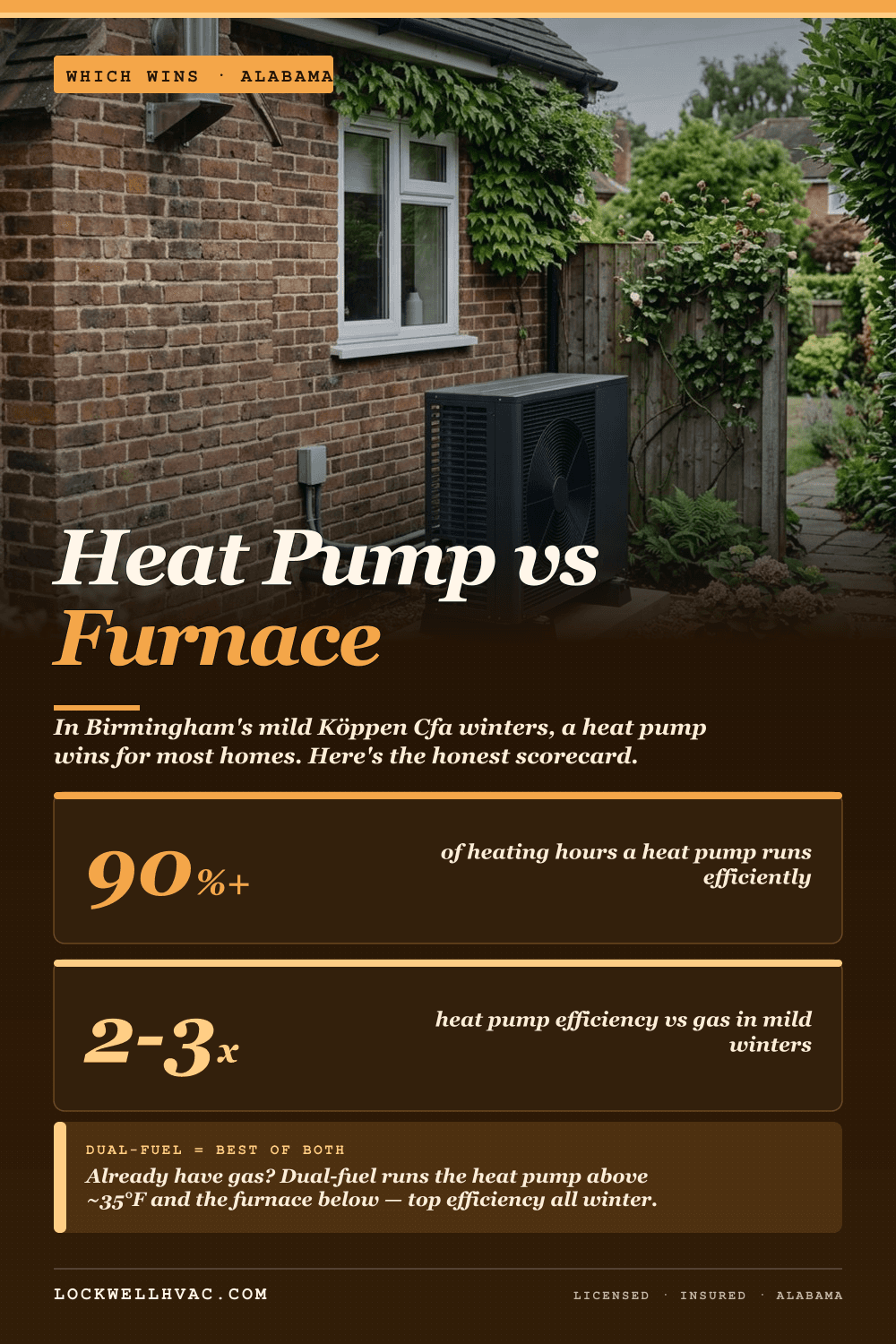
For most Birmingham-area homes, a heat pump wins. Our Köppen Cfa climate has mild winters where a heat pump runs above its 35°F efficiency cliff over 90% of heating hours. Pair it with electric backup or a small dual-fuel gas furnace for cold snaps. Pure gas furnaces only make sense if you already have natural gas service and rarely run AC.
The Honest Answer for North Birmingham
You searched "heat pump vs furnace" because you're staring down a system replacement and a contractor just told you something that sounded like a sales pitch. Here is the field-tech version, no commission attached.
In Birmingham, Hoover, Vestavia Hills, Homewood, Mountain Brook, and Trussville — anywhere in our Köppen Cfa humid subtropical climate — a heat pump is the more efficient pick for most homes. We get maybe 5 to 10 nights a winter that drop below 25°F. The rest of heating season runs in the 35°F-to-55°F band where heat pumps absolutely shine.
A pure gas furnace makes sense in three cases: you already have a natural gas line, you live in an older home with a working chimney chase, or you almost never run cooling. Otherwise, you're paying to install and maintain two separate pieces of equipment when one heat pump does both jobs.
How much more efficient a heat pump is than electric resistance heat or a gas furnace in Alabama's mild winters, per the U.S. Department of Energy
How a Heat Pump Actually Works (and Why It Crushes a Furnace Here)
A furnace burns fuel — natural gas, propane, or oil — and converts that energy directly into heat. Even a 96% AFUE high-efficiency furnace caps at 96% of the fuel energy reaching your air. Burn a dollar of gas, get 96 cents of heat. That's the ceiling.
A heat pump doesn't make heat. It moves it. Even in 40°F outdoor air, there's enormous thermal energy out there. The heat pump's refrigerant cycle pulls that heat in and concentrates it. According to the U.S. Department of Energy, modern heat pumps deliver 2 to 3 times more heat energy per unit of electricity than electric resistance heaters. That's a Coefficient of Performance (COP) above 3.0 — burn a dollar of electricity, get three dollars of heat.
In our Birmingham climate, the math gets stupid in your favor. Most winter mornings sit in the 30s and 40s. That's exactly the temperature band where a heat pump runs at peak efficiency. A 96% gas furnace can't touch a heat pump pulling COP 3.5 in 45°F weather.
When a Heat Pump Struggles (And Why It Doesn't Matter Much in Alabama)
Heat pumps lose efficiency as outdoor temperatures drop. Below about 35°F, capacity falls. Below about 17°F, most standard heat pumps switch to backup electric resistance heat — which is the same expensive electric heat your grandmother paid for in 1985.
Here's the Alabama climate reality. According to NOAA Climate Normals for Birmingham, our average January low is around 33°F. We see brief dips into the teens during arctic blasts, but those are short windows — usually 2 to 4 days.
That means your heat pump runs in its efficient band for the overwhelming majority of heating hours each winter. The handful of bitter cold nights when backup heat kicks in cost more, but they're rare enough that the annual math still favors the heat pump heavily.
If you live in Birmingham, Gardendale, Hoover, Vestavia Hills, or Trussville, count the days last winter when it dropped below 17°F. Probably 3 to 6. That's how often your heat pump backup heat would have run. The rest of the season, your old gas furnace was burning money the heat pump would have saved.
What About a Dual-Fuel System?
A dual-fuel system pairs an electric heat pump with a gas furnace as backup. The thermostat watches outdoor temperature and switches automatically. Above the changeover point (usually set around 35°F to 40°F), the heat pump handles heating cheaply. Below that, the furnace fires up.
For Birmingham homes that already have natural gas service, dual-fuel is genuinely the highest-efficiency setup available. You get heat-pump economics for 90%+ of heating hours and gas-furnace performance for the cold snaps. The downside is upfront cost — you're buying two heating systems instead of one.
If you don't have gas service, electric backup heat (the standard heat pump configuration) is fine for our climate. The few hours per year backup runs simply don't move the bill enough to justify running gas line.
Cost Comparison: Real Numbers for Alabama
Equipment costs swing wildly based on tonnage, efficiency tier, and contractor markup. But the rough order of magnitude for a typical Birmingham 1,800-square-foot home looks like this.
A standard 80% AFUE gas furnace plus matching air conditioner sits in one cost band. A 16-SEER2 heat pump (no separate AC, no separate furnace) sits in roughly the same band. A 17-SEER2 dual-fuel system with a 90%+ AFUE gas furnace runs higher because you're buying both pieces of equipment.
Operating costs is where the gap widens fast. The ENERGY STAR heat pump comparison shows that switching from electric resistance heat to a modern ENERGY STAR-certified heat pump saves homeowners roughly 50% on heating costs annually. From oil furnace heating, savings can hit 60%+. From gas furnace, savings are smaller but still material in mild climates like ours.
Average heating cost reduction when switching from electric resistance heat to an ENERGY STAR heat pump, per ENERGY STAR data
Lifespan and Maintenance Reality
A well-maintained gas furnace lasts 15 to 20 years. A heat pump runs both heating and cooling cycles year-round, so it accumulates run-hours faster — typical lifespan is 12 to 15 years according to the ASHRAE equipment service life database.
That sounds like a heat pump disadvantage, but consider what you're replacing. A gas furnace plus a separate AC means you're replacing two pieces of equipment over their respective lifespans. A heat pump bundles both functions into one outdoor unit. When the heat pump dies, you replace one system instead of two.
Maintenance requirements are similar — annual professional tune-ups, monthly filter changes during cooling season, and yearly coil cleaning. Heat pumps need slightly more attention to defrost cycle behavior and reversing valve operation, but those are technician-side concerns, not homeowner ones.
Humidity Control: The Hidden Birmingham Factor
Alabama's killer issue isn't temperature — it's humidity. Our 70%+ summer relative humidity destroys homes from the inside out if HVAC equipment doesn't pull moisture out of the air aggressively.
Modern variable-speed heat pumps handle humidity better than older single-stage systems and most gas-furnace-paired AC units. They run longer at lower capacity, which extends the dehumidification cycle. A two-stage or variable-speed heat pump in a Hoover or Vestavia Hills home maintains comfort with less raw cooling than an oversized single-stage system would need.
This matters more than most homeowners realize. A house at 76°F with 50% humidity feels colder than a house at 72°F with 65% humidity. The right equipment lets you set the thermostat higher, which cuts the bill.
Which One Wins for Your House?
Pick a heat pump if: your home has electric heat already, you don't have natural gas service, you're replacing both AC and furnace at the same time, your home is reasonably tight (built or upgraded after 2000), or you want a single piece of equipment to maintain.
Pick a gas furnace plus separate AC if: you already have natural gas service and a working flue, your AC is newer than your furnace and you only need to replace heating, you live in an older home with significant air leakage that would tax a heat pump, or your contractor is offering a serious price advantage on the furnace combo (rare).
Pick a dual-fuel system if: you have natural gas, you can swing the higher upfront cost, and you want maximum efficiency across our entire weather range.
For an honest assessment of your specific Birmingham home, see our HVAC installation guide, our heat pump service page, and SEER ratings explained for Birmingham homes. For neighborhood-specific comfort considerations, our Birmingham service area page covers the local conditions our techs see daily.
Need HVAC service in the Birmingham area?
Available 24/7. Licensed and insured. Written estimates before work begins.
Call (205) 206-7030Frequently Asked Questions
Visual Guide
Compiled by the HVAC technicians at Lockwell HVAC in Gardendale, Alabama. The comparisons and explanations here are grounded in what we install and service every week across the North Birmingham metro, so the trade-offs reflect how systems hold up in Alabama homes rather than spec-sheet claims.
- U.S. Department of Energy — Energy efficiency and maintenance guidelines
- ENERGY STAR — Thermostat and installation efficiency standards
- ASHRAE — Coil cleaning and maintenance guidelines
- ACCA — Manual J load calculation standards and equipment lifespan data
- U.S. EPA — Refrigerant regulations and indoor air quality guidance
- NFPA — Electrical safety and fire prevention
- CPSC — Carbon monoxide safety data
- NADCA — Duct cleaning standards
Bookmark this page for reference. Share it with a neighbor who might find it useful. If you have questions about anything covered here, call us directly — a real person answers, not a recording.
Read Next