Who Installs Thermostats — And When You Need a Pro
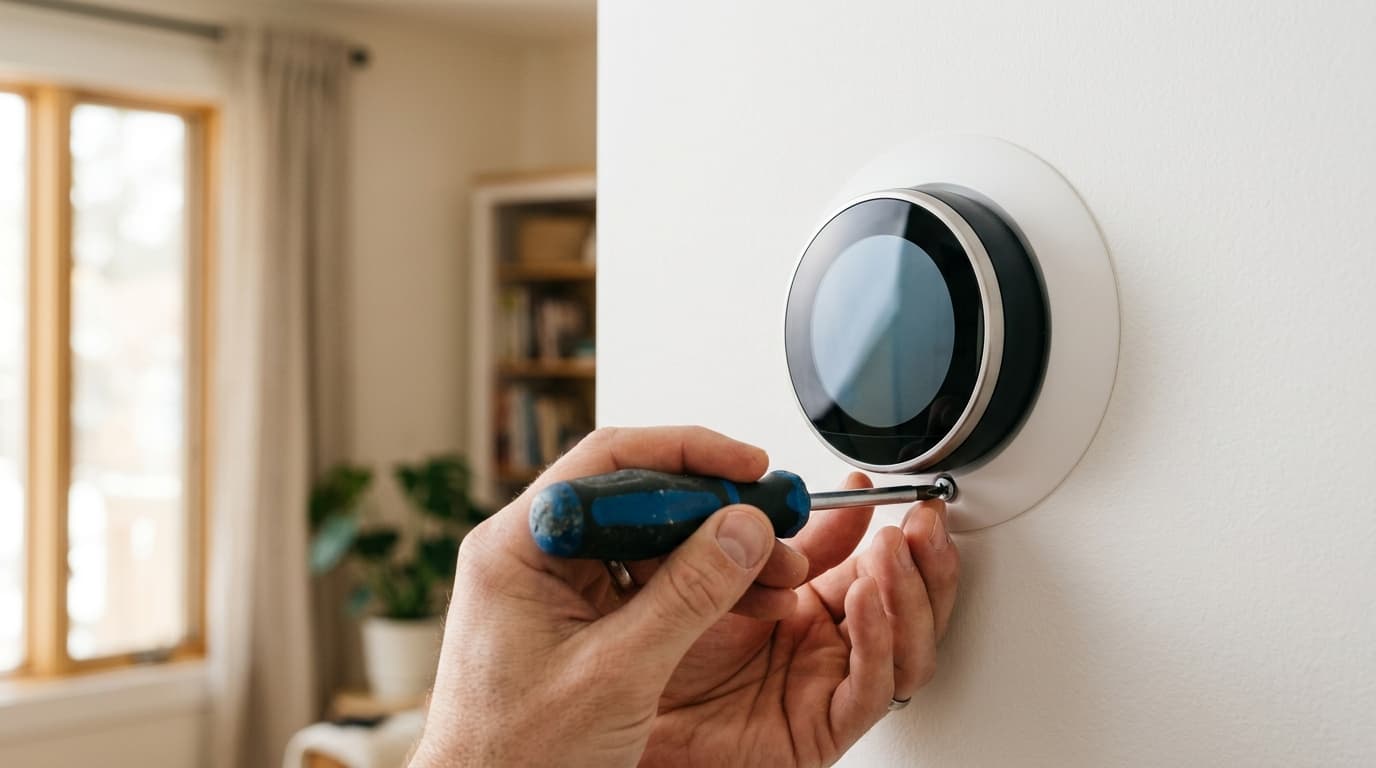
Any homeowner can replace a like-for-like thermostat if the wiring is standard. A licensed HVAC technician installs thermostats when the wiring is non-standard, when you're upgrading to a smart thermostat on a heat pump, or when the system doesn't respond correctly after a DIY swap. Lockwell HVAC handles thermostat installation and wiring diagnostics across the Gardendale and Birmingham area.
Thermostats Are Simple Until They're Not
Swapping a basic thermostat seems like a weekend job. Most of the time it is. Pull the old one off the wall, photograph the wiring, match the terminals on the new unit, done.
Then you're an hour in, staring at a C-wire that doesn't exist, a heat pump that won't switch modes, or an Ecobee showing an error code you've never seen. That's when the job stops being a weekend project and turns into a service call anyway.
Knowing which side of that line your situation falls on saves you time, frustration, and the risk of damaging equipment that costs thousands of dollars to replace.
Standard Thermostat Wiring — What You're Working With
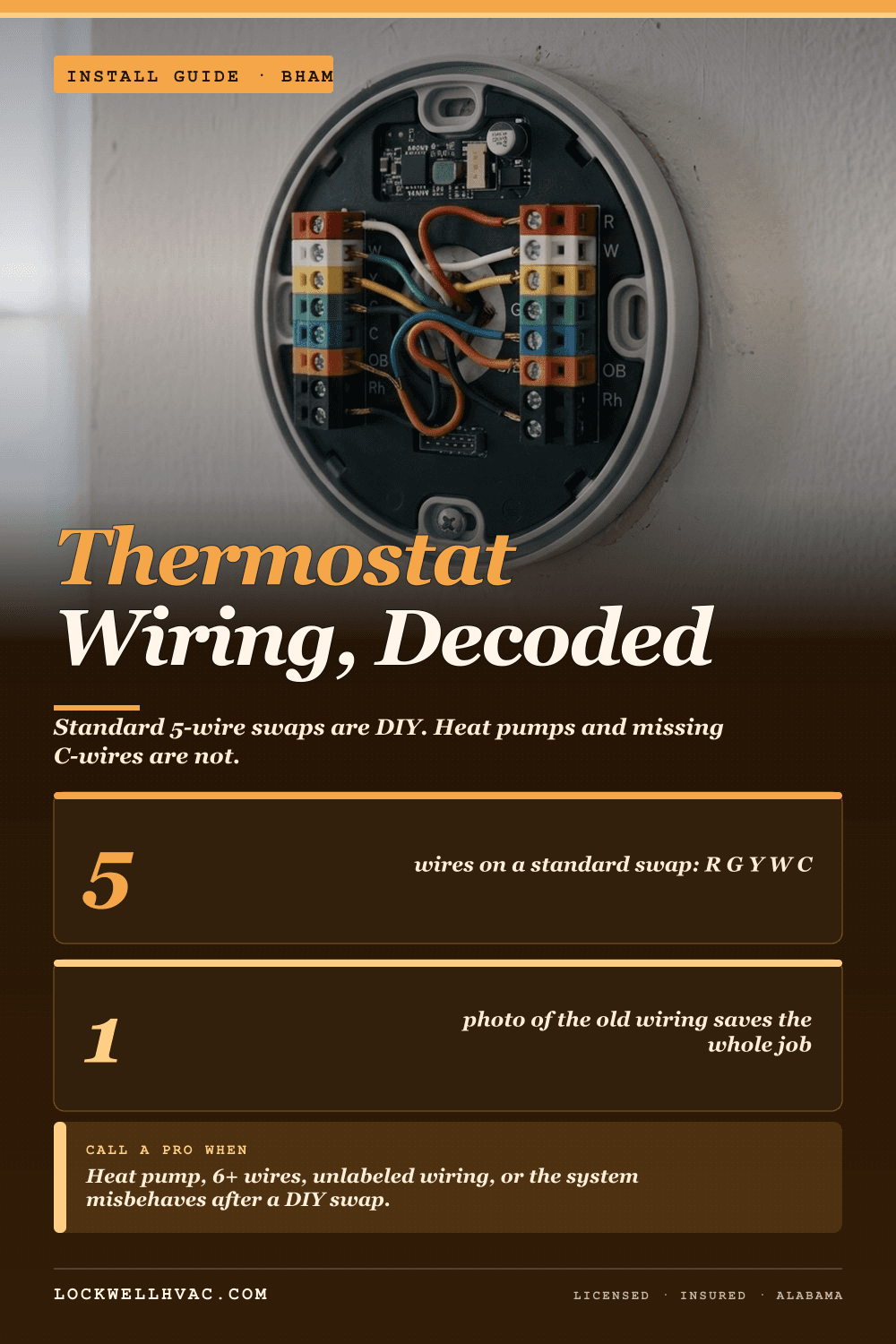
Most forced-air systems in the Birmingham area use a standard 5-wire low-voltage setup. The wires are color-coded by convention, not by code, but the colors are consistent enough that they serve as a reliable guide:
- **R or Rh**: 24V power from the transformer (red) - **G**: Fan only (green) - **Y**: Cooling / compressor (yellow) - **W**: Heating / heat strip or furnace (white) - **C**: Common wire — completes the circuit back to the transformer (blue or black)
A system with all five of these wires runs every modern smart thermostat without adapters. If you're missing the C-wire — common in older homes and systems installed before smart thermostats became standard — you have options: use a C-wire adapter kit, run a new wire, or use a thermostat with a power-stealing circuit like certain Honeywell models.
Heat pumps add complexity. They use the **O/B** terminal to control the reversing valve — the component that switches between heating and cooling modes. Nest calls it O/B. Ecobee calls it O/B. The setting matters: O-type (energized in cooling) versus B-type (energized in heating) must match your specific system. Getting it wrong means your heat pump heats when it should cool and vice versa.
Connecting the O and B terminals incorrectly on a heat pump, causing reversed heating/cooling operation
Nest Thermostat Installation — What to Know
Nest thermostats are the most common smart thermostat we're called to troubleshoot after a DIY install. Three situations cause most of the problems:
**Missing C-wire.** Nest Learning Thermostat models use a power-stealing circuit that draws small amounts of power from the R and Y wires. On some systems — particularly those with variable-speed blowers or systems with short wire runs — this causes battery drain, ghosting behavior, or the blower running when it shouldn't. The proper fix is adding a C-wire, either by running new wire or using a Nest adapter. Nest's own documentation walks through this, but interpreting it requires knowing what equipment you have.
**Heat pump O/B configuration.** Nest's app walks you through this during setup, but it asks you questions that assume you know what type of heat pump you have. If you don't know whether your reversing valve is O-type or B-type, this is a guess. A wrong guess runs your system in the wrong mode. If you're sizing or replacing the equipment behind that thermostat, see why your electric bill is so high in summer Alabama — wrong-mode operation is a leading culprit.
**Dual-fuel systems.** A heat pump with a gas furnace backup (dual-fuel) requires an aux/emergency heat terminal and correct staging logic. The Nest Learning Thermostat handles dual-fuel, but the wiring is more complex than a single-stage system. The Nest E does not support dual-fuel — a compatibility check matters before purchase.
Ecobee Thermostat Installation
Ecobee thermostats include a Power Extender Kit (PEK) in the box specifically to address the missing C-wire issue. The PEK installs at the furnace control board and converts an existing wire into a C-wire. It works reliably in most systems.
Ecobee's installation guide is thorough and includes heat pump configuration. The app walks through wiring step by step. For a standard forced-air system with five wires, Ecobee is the most DIY-friendly of the major smart thermostat brands.
Where Ecobee gets complicated: multi-stage systems (two-stage compressors, two-stage furnaces), zoned systems with a zone controller, and radiant heating systems. If your system has more than five wires, photograph all of them and check Ecobee's compatibility tool before buying.
Ecobee's Power Extender Kit solves the missing C-wire problem for most Birmingham homeowners without running new wire. If your system has more than five wires, verify compatibility before purchasing.
Honeywell / Resideo Thermostat Installation
Honeywell's thermostat line ranges from basic non-programmable units to the T9 and T10 Pro smart thermostats. Honeywell offers the widest range of thermostat types and is the most common brand in existing Birmingham homes.
For like-for-like replacement of a Honeywell with another Honeywell, the wiring typically maps directly. Honeywell's T6 Pro and T9 support a wider range of system configurations than Nest or Ecobee and are more commonly used in commercial or complex residential applications.
One advantage of Honeywell for heat pump applications: the T9 and T10 Pro have a dedicated O/B terminal with configurable logic and explicit documentation for Trane, Carrier, and Lennox heat pump compatibility — systems common across the Birmingham metro.
When to Call a Licensed HVAC Technician for Thermostat Work
Call a technician rather than DIY when:
**Your system uses a heat pump.** Reversing valve wiring, aux heat staging, and defrost control wiring are not forgiving of mistakes. One wrong terminal connection runs your compressor in a mode it wasn't designed for under the conditions present, which stresses equipment.
**You have more than six wires.** Multi-stage systems, humidifiers, dehumidifiers, zoning systems, and energy recovery ventilators all add wires. Identifying each one requires knowledge of your specific control board.
**The old thermostat wiring is unlabeled.** Previous work may not match color conventions. Tracing unlabeled wires without a wiring diagram means guessing, which means potential equipment damage.
**The system doesn't respond correctly after a DIY swap.** If your AC runs when heat is called, your heat doesn't come on at all, or your fan runs constantly, stop troubleshooting and call. These symptoms indicate a wiring error that can damage the transformer or control board if left running.
**You're installing in a new location without existing wiring.** Running new low-voltage thermostat wire is straightforward but requires access through walls and ceilings and knowledge of your system's wire requirements.
Per NEC 2023 requirements, low-voltage thermostat wiring (Class 2 circuits) does not require a permit in most jurisdictions, but incorrect installation that causes equipment damage or fire is still a liability. When in doubt, call.
Need HVAC service in the Birmingham area?
Available 24/7. Licensed and insured. Written estimates before work begins.
Call (205) 206-7030Frequently Asked Questions
Visual Guide
Compiled by the HVAC technicians at Lockwell HVAC in Gardendale, Alabama. The comparisons and explanations here are grounded in what we install and service every week across the North Birmingham metro, so the trade-offs reflect how systems hold up in Alabama homes rather than spec-sheet claims.
- U.S. Department of Energy — Energy efficiency and maintenance guidelines
- ENERGY STAR — Thermostat and installation efficiency standards
- ASHRAE — Coil cleaning and maintenance guidelines
- ACCA — Manual J load calculation standards and equipment lifespan data
- U.S. EPA — Refrigerant regulations and indoor air quality guidance
- NFPA — Electrical safety and fire prevention
- CPSC — Carbon monoxide safety data
- NADCA — Duct cleaning standards
Bookmark this page for reference. Share it with a neighbor who might find it useful. If you have questions about anything covered here, call us directly — a real person answers, not a recording.
Read Next