How Often to Change Your Air Filter in Alabama | Lockwell HVAC
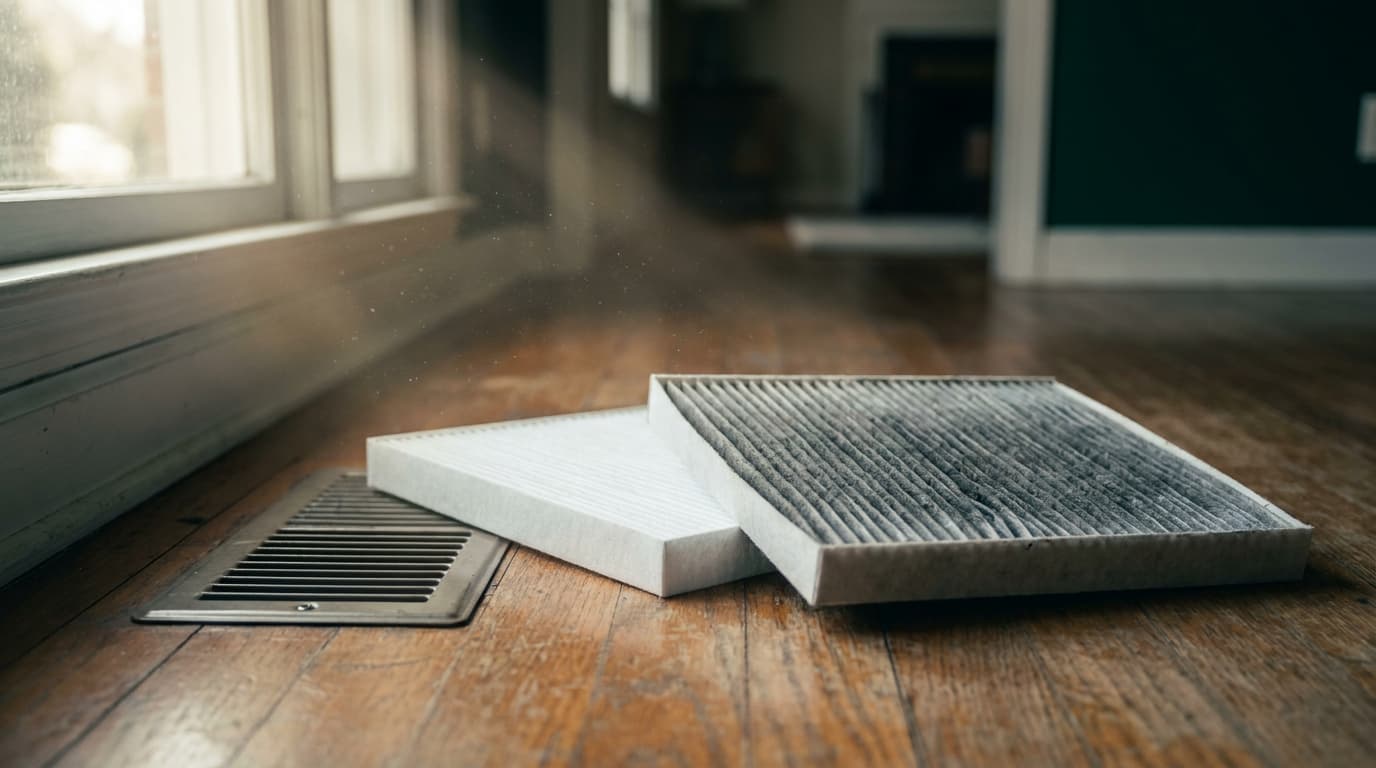
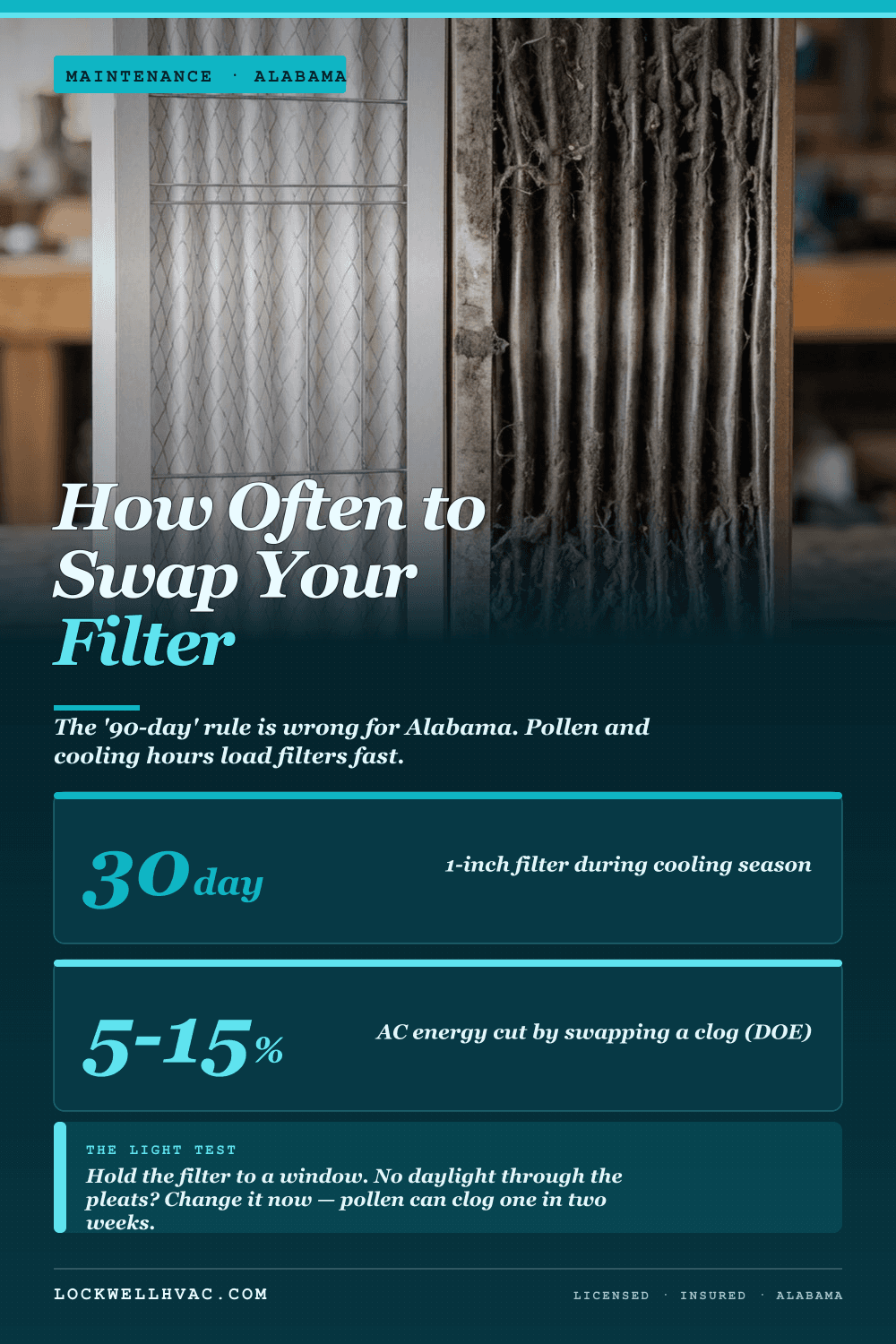
Standard 1-inch filters need replacement every 30 days during cooling season (April through October) and every 60 days otherwise. 4-inch media filters last 90 days year-round. Pets, pollen-heavy weeks, and renovation dust shorten these intervals. The single most reliable check: hold the filter to a window — if you can't see daylight through it, change it now.
The 30-Day Rule (And When It's Wrong)
Generic HVAC advice says "change your filter every 90 days." That's the manufacturer-printed number you see on filter packaging, and it's wrong for almost every Alabama home.
The 90-day number comes from EPA testing in moderate climates with average pollen, no pets, and dry conditions. Birmingham, Hoover, Mountain Brook, and the rest of the metro give your filter none of those advantages. Our filters work harder for three reasons: high cooling hours mean more air pulled through them, brutal pollen seasons mean dense particulate loading, and humidity means anything that lands stays.
The rule that actually works for Alabama:
**1-inch filter, cooling season (April-October):** every 30 days.
**1-inch filter, off-season (November-March):** every 60 days.
**2-inch filter:** every 60 days year-round.
**4-inch media filter:** every 90 days year-round.
**Households with pets, smokers, or active renovation:** subtract 30 days from each of the above.
Recommended replacement interval for 1-inch filters during Alabama cooling season — half the off-season interval
Why Filters Matter More Than Most Homeowners Think
A clogged filter isn't just an air-quality issue. It's a money issue.
According to the U.S. Department of Energy, replacing a clogged filter with a clean one can lower your air conditioner's energy consumption by 5% to 15%. That's measurable on your monthly Alabama Power bill — a typical $300 summer cooling bill drops $15 to $45 with one $15 filter swap.
A clogged filter also forces the blower to work harder, increases static pressure across the system, raises evaporator coil temperatures unpredictably, and can cause the entire system to freeze up. We covered freeze-ups in detail in our AC freezing up guide — the most common cause we see is a forgotten filter.
Long-term, a chronically dirty filter sends particulates around the filter (through gaps and bypass paths), depositing them on the evaporator coil. A coated coil loses heat-transfer efficiency permanently and is expensive to clean.
Birmingham's Pollen Reality
The Asthma and Allergy Foundation of America regularly ranks Birmingham among the top 30 most challenging U.S. cities for spring pollen. We average over 100 days per year with measurable airborne pollen, with peaks in late February through April that can clog a 1-inch filter in two weeks.
Tree pollen (oak, pine, hickory, elm) dominates February to May. Grass pollen takes over May through July. Ragweed hits late July through October. There's barely a window all year where pollen isn't loading filters somewhere.
If you have allergies, the filter you're using matters as much as how often you change it. MERV 11 to 13 filters capture pollen, mold spores, and pet dander dramatically better than MERV 6-8 economy filters — but they need more frequent changes because they catch more.
For severe allergy households, ASHRAE's guidance on residential filtration is more useful than the generic boxes-on-shelves advice. MERV 11 minimum, MERV 13 if your system can handle the static pressure (most modern systems can; some older variable-speed setups can't).
How to Check a Filter the Right Way
The hold-it-to-light test is the most reliable home check. Pull the filter, walk to a window, hold it up. You should see clear daylight through the pleats. If you see a gray haze or can't see light at all, that filter is restricting airflow and burning extra electricity every minute the AC runs.
Don't trust calendar reminders alone. A "monthly" reminder that fires on April 1st means nothing if pollen counts spiked the third week of March and your filter is gray by April 1st. Check after big pollen surges (any day yellow dust covers your car), after household renovations, and after pet-shedding seasons.
Buy a 6-pack of filters at a time and store them in a closet near the return vent. Eliminate the "I need to go to the store" friction. Set a phone alarm for the 1st of every month from April through October. Pull the old filter, hold it to light, swap if cloudy. The 60-second habit saves $200+ per cooling season.
Filter Type: What to Buy
Filters are rated MERV (Minimum Efficiency Reporting Value) 1 through 16. Higher is finer filtration but also higher static pressure on your system.
**MERV 6-8 (economy fiberglass):** Cheap. Catches dust and lint. Doesn't catch pollen, pet dander, or mold spores effectively. Use only if recommended by your specific equipment manufacturer.
**MERV 9-11 (standard pleated):** The Alabama default. Catches pollen, dander, and most mold spores. Static pressure penalty manageable on virtually all residential systems.
**MERV 12-13 (high efficiency pleated):** Recommended for allergy households or homes with smokers. Catches finer particulates including some bacteria and virus carriers. Verify your system can handle the static pressure — most can, some older systems can't.
**MERV 14-16 (HEPA-class):** Hospital-grade. Most residential HVAC blowers can't push enough air through these without aftermarket modifications. Don't install without professional consultation.
The EPA's air filter guidance is a useful reference for matching filter type to household needs.
What Frequency Looks Like by Household Type
**Newer Vestavia Hills home, no pets, no allergies, MERV 8 filter:** 1-inch every 45 days in cooling season, 75 days off-season. 4-inch media filter every 100 days year-round.
**1990s Hoover home, two dogs, MERV 11 filter:** 1-inch every 21 days in cooling season, 45 days off-season. The dogs put roughly 30% extra load on the filter.
**Mountain Brook home, severe seasonal allergies, MERV 13:** 1-inch every 21 to 30 days year-round. The high-MERV filter catches more (good for indoor air) and clogs faster (replacement cost trade-off).
**Older Birmingham home with significant air leakage, no pets, MERV 8:** 1-inch every 30 days year-round. Air leaks pull more outdoor pollen and dust through the system, loading filters faster.
**Active renovation or recent move-in dust:** 1-inch weekly until the visible dust load drops, then return to standard schedule.
Common Filter Mistakes
**Mistake #1: Buying the wrong size.** Every system has a specific filter slot dimension. Stuffing a slightly-too-small filter in creates bypass gaps that defeat filtration entirely. Measure once, buy in bulk, never compromise size.
**Mistake #2: Installing backward.** Filters have an airflow direction arrow. Reversed installation reduces efficiency and can collapse the pleats inward over time. Always check the arrow.
**Mistake #3: Buying the cheapest filter every time.** A $3 fiberglass filter passes more particulates to your evaporator coil than a $15 MERV 11 pleated. The coil cleaning cost when that grime builds up dwarfs years of filter savings.
**Mistake #4: Forgetting return-grille filters.** Some homes have filters at each return grille rather than at the air handler. If yours does, every grille filter needs the same monthly attention — not just the one in the hallway you remember.
**Mistake #5: Skipping the off-season.** Heating systems still pull air through the same filter. Burning fuel through a clogged filter is just as wasteful as cooling through one. November-through-March changes matter.
For ongoing maintenance support, see our HVAC maintenance plans, duct cleaning service, and indoor air quality service. Local context for Birmingham homeowners is in the area pages.
Need HVAC service in the Birmingham area?
Available 24/7. Licensed and insured. Written estimates before work begins.
Call (205) 206-7030Frequently Asked Questions
Visual Guide
Compiled by the HVAC technicians at Lockwell HVAC in Gardendale, Alabama. The maintenance guidance here reflects what we check on real service calls across the North Birmingham metro — coil condition, refrigerant pressures, electrical draw, and the seasonal wear that Alabama heat and humidity put on residential systems.
- U.S. Department of Energy — Energy efficiency and maintenance guidelines
- ENERGY STAR — Thermostat and installation efficiency standards
- ASHRAE — Coil cleaning and maintenance guidelines
- ACCA — Manual J load calculation standards and equipment lifespan data
- U.S. EPA — Refrigerant regulations and indoor air quality guidance
- NFPA — Electrical safety and fire prevention
- CPSC — Carbon monoxide safety data
- NADCA — Duct cleaning standards
Bookmark this page for reference. Share it with a neighbor who might find it useful. If you have questions about anything covered here, call us directly — a real person answers, not a recording.
Read Next