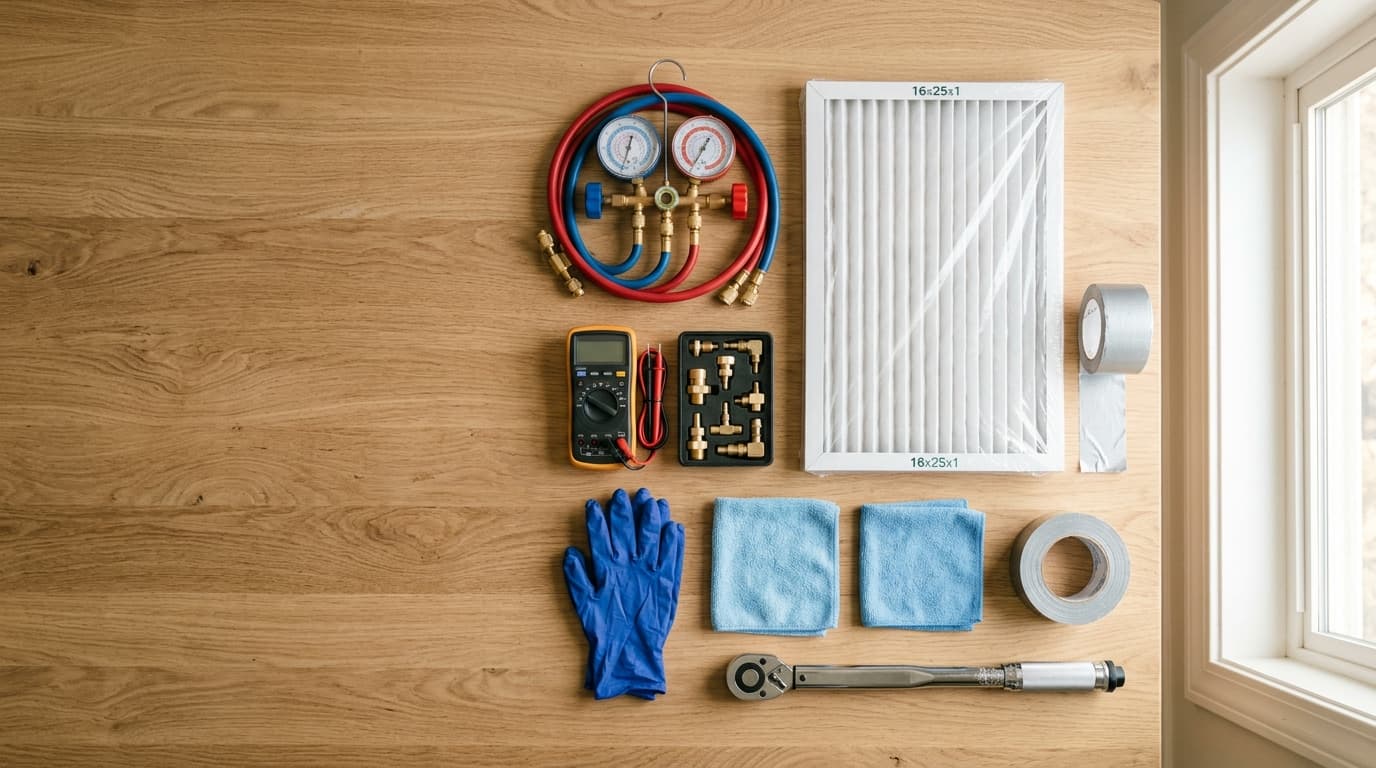
Fall & Winter HVAC Prep Checklist for Alabama Homeowners
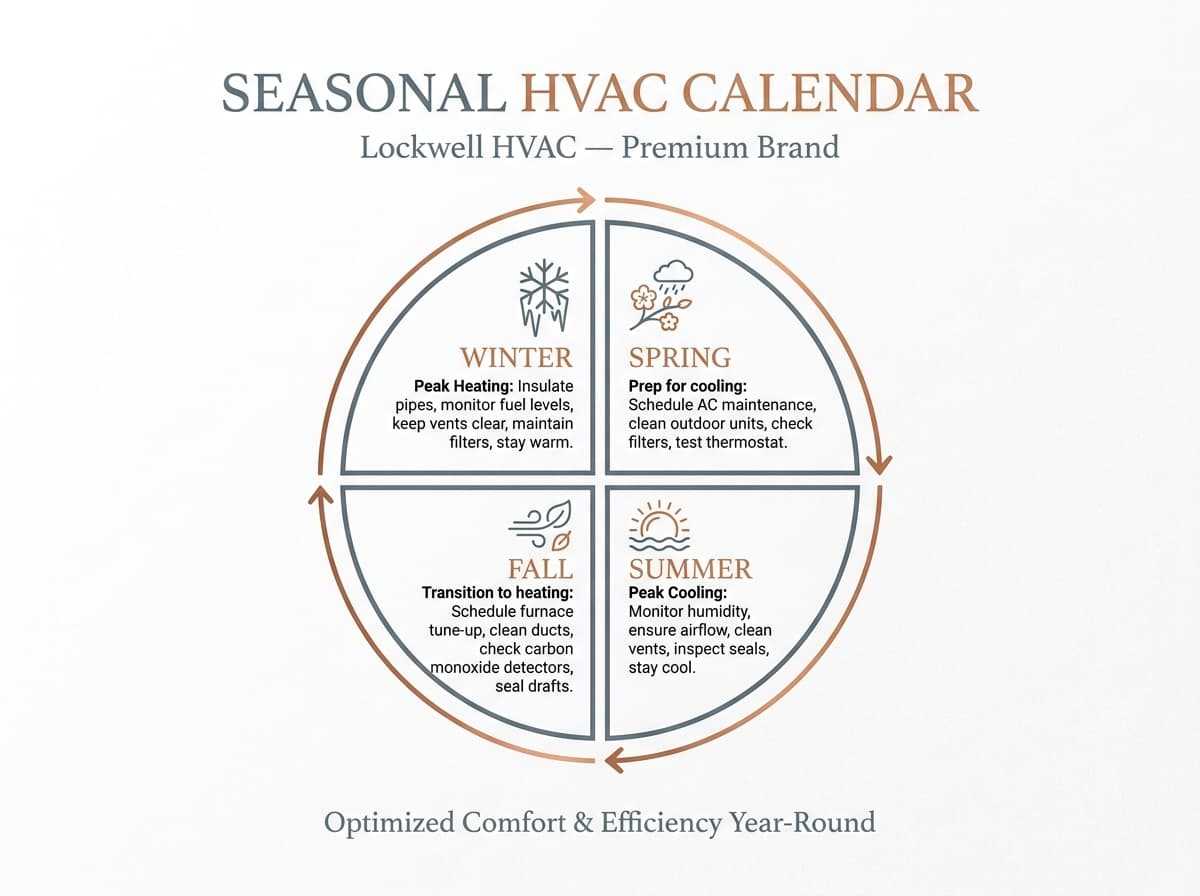
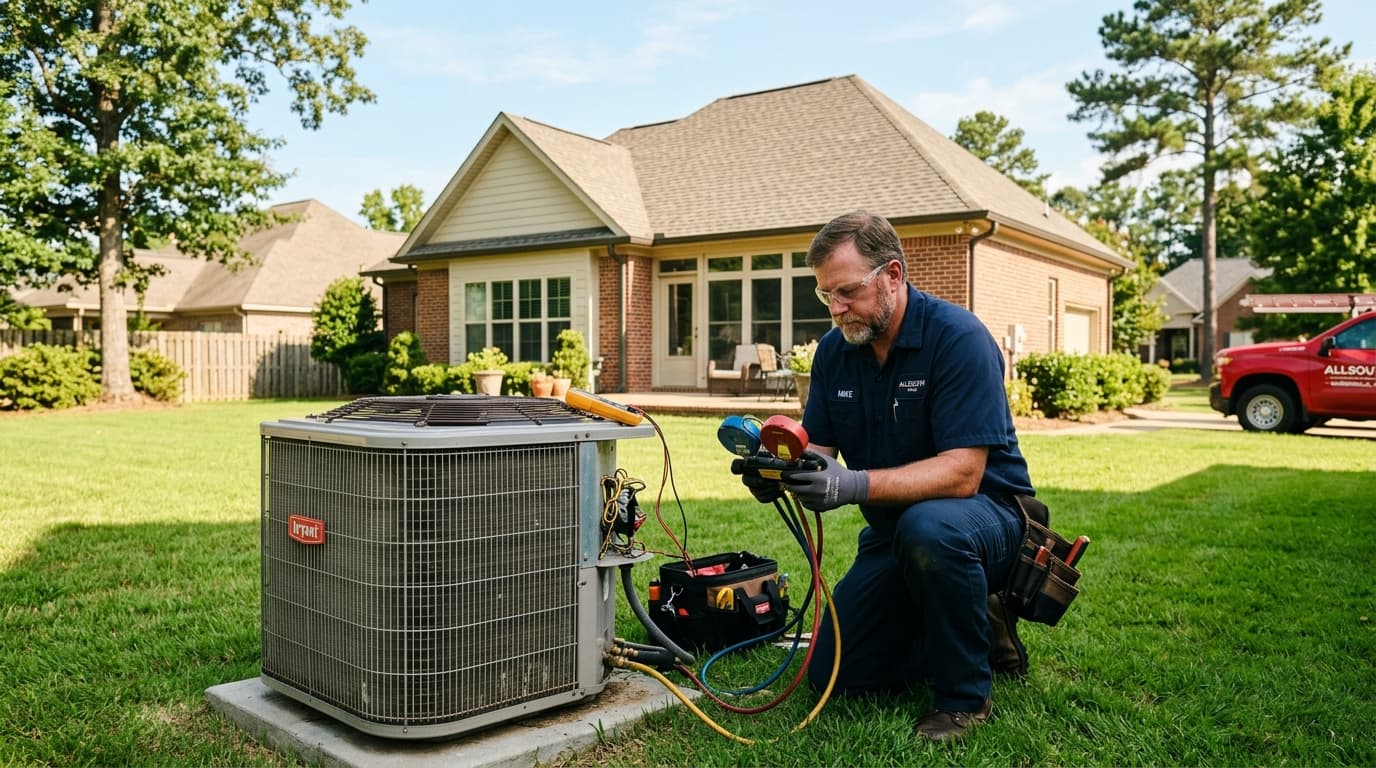
Alabama's heating season is short but demanding. The key prep steps before the first cold night: replace the filter, test heating mode in September while temperatures are still warm, clear the condensate trap, inspect the outdoor unit for debris, and if you have a gas furnace, schedule a combustion analysis and heat exchanger inspection. Freeze protection for the outdoor unit and condensate line avoids the most common winter HVAC emergencies in Gardendale, Fultondale, and north-metro Birmingham.
Download our full **Fall + Winter HVAC Prep Checklist PDF** at the form below — a printable 6-page checklist with NOAA climate thresholds, manufacturer references, and step-by-step prep instructions.
Alabama's Heating Season — Why It Matters
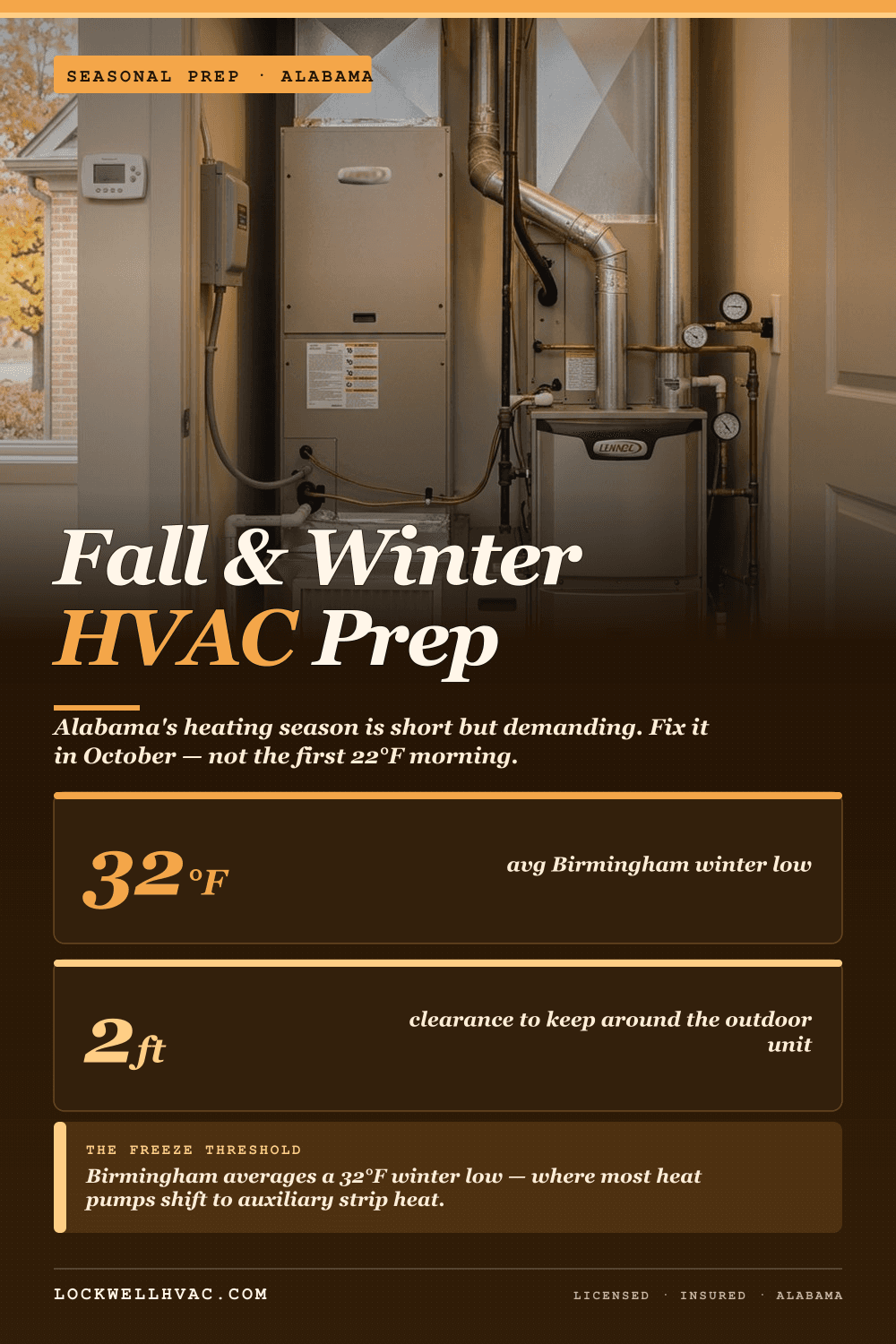
Alabama winter lows average around 32°F across the Birmingham metro (NOAA Birmingham-area climate data at https://www.weather.gov/bmx/climate). That sounds mild compared to northern states, but it masks three realities:
1. **Heating runtime is concentrated.** Our heating season runs roughly November through early March. Systems that worked fine all summer at partial load suddenly get pushed hard for weeks at a time. 2. **Temperature swings are violent.** A 70°F Tuesday followed by a 22°F Wednesday morning is a normal November pattern in Gardendale. Equipment that was not prepped struggles with the transition. 3. **The equipment base is not built for cold.** Many Gardendale and Fultondale homes run heat pumps sized for cooling load with auxiliary electric strip heat for the handful of sub-20°F nights per year. Strip heat that has not been tested since March often has issues no one noticed.
Birmingham-area average winter overnight low per NOAA climate data — the threshold at which most Alabama heat pumps shift from compressor-only operation to supplemental auxiliary strip heat, and the temperature at which prep-skip failures show up.
Step 1 — Replace The Air Filter (Late September / Early October)
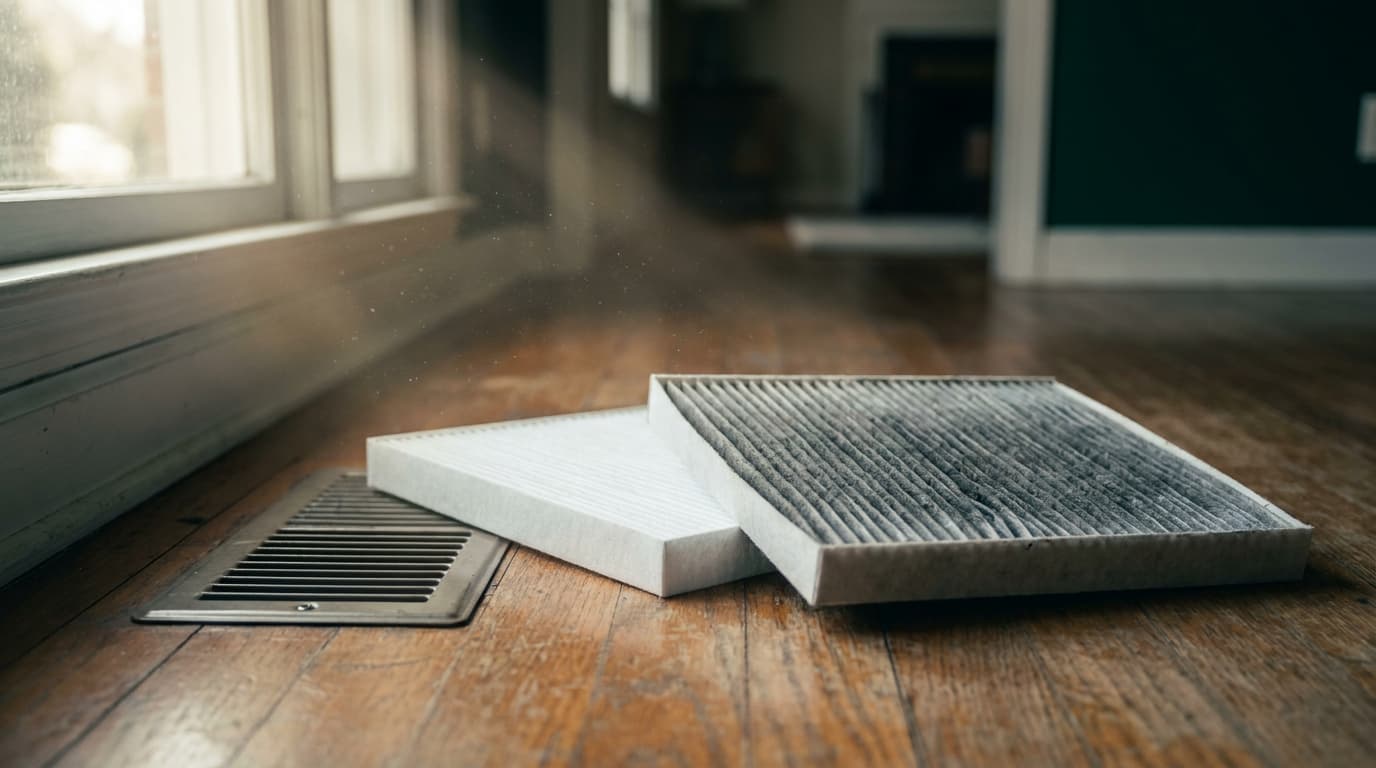
Before any heating-mode test, replace the air filter. A filter that was adequate for summer cooling cycles may be dirtier than it looks after pollen season. A restricted filter causes the same problems in heating as in cooling — reduced airflow, high static pressure, and on gas systems, premature high-limit switch tripping that shuts the furnace down.
Standard 1-inch filters: replace every 30-60 days during heating season. 4-inch media filters: replace every 90 days. Filtrete 1500+ and AprilAire high-efficiency media filters handle winter pollen (from cedars in North Alabama) and dust load well when sized correctly. For the full year-round filter cadence, see how often to change your air filter in Alabama.
Step 2 — Test Heating Mode Early (Early October)
Turn the thermostat up 5 degrees on an October morning when outdoor temps are 55-65°F. Let the system cycle through a full heating call. Listen for anything unusual.
**For heat pumps:** outdoor unit should run, indoor blower should engage, and you should feel warm air at the registers within 2-3 minutes. Warm air — not hot — because heat pumps deliver supply air at 95-105°F versus gas furnaces at 130-140°F.
**For gas furnaces:** the inducer motor should run first, then the igniter should glow (typically 20-45 seconds), then the burners should light with a clean blue flame, then the indoor blower should kick on after another 30-60 seconds. Any unusual noise, smell, or delay is a flag.
**For dual-fuel systems:** confirm the crossover temperature is set correctly. For most Alabama homes, a crossover between 28-32°F means the heat pump handles the mild lows and the gas furnace kicks in for the handful of cold nights.
If the heating mode does not work or behaves oddly, the best time to fix it is October — not the first 22°F morning in December.
Step 3 — Outdoor Unit Inspection
Clear leaves, mulch, and debris from around the outdoor unit. Keep 2 feet of clearance on all sides and 5 feet above. For heat pumps, the outdoor coil runs in reverse during heating mode, so it must shed frost and ice during defrost cycles. Debris blocking airflow extends defrost cycles and reduces heating efficiency.
Check the outdoor unit pad for settling or cracks. A tilted condenser affects oil return to the compressor; a cracked pad can let water infiltrate under the unit.
Visually inspect refrigerant line insulation. Missing or damaged suction-line insulation causes heat loss and condensation problems in winter. Foam line-set insulation is inexpensive and easy to replace.
Step 4 — Condensate System Prep
Heat pumps and high-efficiency condensing gas furnaces both produce condensate during heating operation. The condensate line is the same one that handles summer AC condensate — if it was clogged at summer's end, it is still clogged now.
Clear the primary condensate line. A condensate tablet in the drain pan kills the algae that causes 90% of summer clogs and keeps the line clean through winter. For gas condensing furnaces, verify the neutralizer cartridge (if installed) is not exhausted — the acidic condensate from a 90%+ furnace will corrode cast-iron drainage piping without neutralization.
Step 5 — Gas Furnace Combustion Safety (September / October)
This is the critical fall service step for anyone with a gas furnace. The U.S. Consumer Product Safety Commission publishes annual reports on carbon monoxide exposure; a significant share of residential CO incidents trace to unserviced gas-fired appliances (https://www.cpsc.gov).
A proper fall service includes:
**Visual and borescope heat exchanger inspection.** Camera inspection catches hairline cracks that cannot be seen from the blower cabinet. If a crack is found, the furnace is shut down and replacement is presented — we do not run a known-cracked exchanger through a winter.
**Combustion analysis.** O₂ percentage in flue gas should typically land between 6-9%; CO ppm in flue gas should be under 100 ppm (lower is better); CO at the supply register must be essentially zero. Abnormal readings indicate combustion problems that need adjustment or repair.
**Flame sensor cleaning.** The flame sensor (a small ceramic-coated rod in the flame path) accumulates oxidation over the off-season and loses the ability to prove flame. A sensor that fails intermittently is the most common cause of "furnace lights and shuts off" no-heat calls.
**Gas pressure verification.** Manifold gas pressure should match the manufacturer's nameplate specification. Alabama-area natural gas supply pressure is typically consistent, but regulator drift over time moves manifold pressure out of spec.
**Flue and venting check.** Verify flue is intact, properly supported, and terminates clear of obstructions. For condensing furnaces, verify the condensate vent path is correct.
Step 6 — Heat Pump Defrost Cycle Test
On a cool morning — ideally below 40°F — observe a defrost cycle. Most heat pumps defrost every 30-90 minutes during heating operation when outdoor coils ice up. A normal defrost:
- Lasts 5-10 minutes - Causes a loud "whoosh" as the reversing valve shifts - Produces visible steam from the outdoor coil - Ends with a second reversing-valve shift back to heating mode
Defrost cycles that run longer than 10 minutes, occur too frequently, or fail to clear ice indicate a defrost-control problem. Likely causes: failed defrost board, stuck reversing valve, or refrigerant charge issues. Catch it in October, not January.
Step 7 — Auxiliary Strip Heat Test (For Heat Pumps)
Auxiliary electric strip heat is the backup heating source on most Alabama heat pumps. It kicks in when: - Outdoor temperature drops below the balance point (typically 28-32°F) - The heat pump is in defrost mode - The thermostat is set 3+ degrees above current room temperature
Force an aux call by setting the thermostat 5+ degrees above room temperature and monitoring the current draw at the air handler. Aux strip heat draws significant current — 30-50 amps per 5kW strip. If strips do not engage, they may be tripped at the breaker, failed, or the sequencer may have issues.
Strip heat that does not work becomes obvious at 6 AM on a 20°F morning when the system cannot maintain setpoint. Fix it in October.
Step 8 — Thermostat Programming Review
Reset the thermostat schedule for the heating season. ENERGY STAR recommends 68°F when home and 60-62°F when away or asleep (https://www.energystar.gov/products). For heat pumps, avoid large setbacks — a 10+ degree setback forces auxiliary strip heat to recover, which costs more in electricity than the setback saves.
For Nest Learning Thermostat and Ecobee Smart Thermostat Premium users, enable "heat pump balance" or equivalent features that limit aux strip usage during setback recovery.
Step 9 — Humidifier Prep (If Installed)
Whole-home humidifiers (AprilAire 600, Honeywell TrueEASE, etc.) need a fall service before winter heating dries out indoor air.
**Replace the water panel / pad.** Annual replacement is standard. The old pad is mineral-scaled and reduces humidification capacity.
**Check the drain line.** Flow-through humidifiers dump significant water during operation. A clogged drain floods the furnace cabinet.
**Verify humidistat setting.** Target 30-40% RH indoors during heating season. Higher than that causes condensation on windows and in wall cavities; lower than that causes dry skin, static electricity, and respiratory irritation.
Step 10 — Freeze Protection
For outdoor units, ensure the condensate drain (on heat pumps during defrost) does not terminate where runoff can freeze into a skating rink near a walking path. Re-route if needed.
For condensate lines on high-efficiency furnaces, confirm any exterior portion is insulated and sloped consistently downhill to prevent ice dams in the line.
For homes with exposed whole-home humidifier supply lines in unconditioned attic or crawl space, add pipe insulation to prevent freeze damage.
Download The Full Checklist
The full printable **Fall + Winter HVAC Prep Checklist** PDF is delivered by email when you submit the form below. It includes:
- Month-by-month prep calendar - Heat pump vs gas furnace checklists - NOAA freeze-threshold data for the Birmingham metro - Manufacturer reference links for Trane, Carrier, Lennox, Rheem - Auxiliary strip heat sizing reference - Dual-fuel crossover temperature guide
Request the PDF at the form below.
<!-- LEAD_MAGNET: fall-winter-prep-checklist -->
Related Services
- Heating Repair — see /services/heating-repair - HVAC Maintenance plans — see /services/maintenance - AC Repair (for spring prep) — see /services/ac-repair - Heat Pump Service — see /services/heat-pump
Need HVAC service in the Birmingham area?
Available 24/7. Licensed and insured. Written estimates before work begins.
Call (205) 206-7030Frequently Asked Questions
Get the free checklist
Enter your email and we will send the printable PDF to your inbox.
Visual Guide
Compiled by the HVAC technicians at Lockwell HVAC in Gardendale, Alabama. The maintenance guidance here reflects what we check on real service calls across the North Birmingham metro — coil condition, refrigerant pressures, electrical draw, and the seasonal wear that Alabama heat and humidity put on residential systems.
- U.S. Department of Energy — Energy efficiency and maintenance guidelines
- ENERGY STAR — Thermostat and installation efficiency standards
- ASHRAE — Coil cleaning and maintenance guidelines
- ACCA — Manual J load calculation standards and equipment lifespan data
- U.S. EPA — Refrigerant regulations and indoor air quality guidance
- NFPA — Electrical safety and fire prevention
- CPSC — Carbon monoxide safety data
- NADCA — Duct cleaning standards
Bookmark this page for reference. Share it with a neighbor who might find it useful. If you have questions about anything covered here, call us directly — a real person answers, not a recording.
Read Next