Variable-Speed vs Single-Stage HVAC in Alabama: The Real Decision
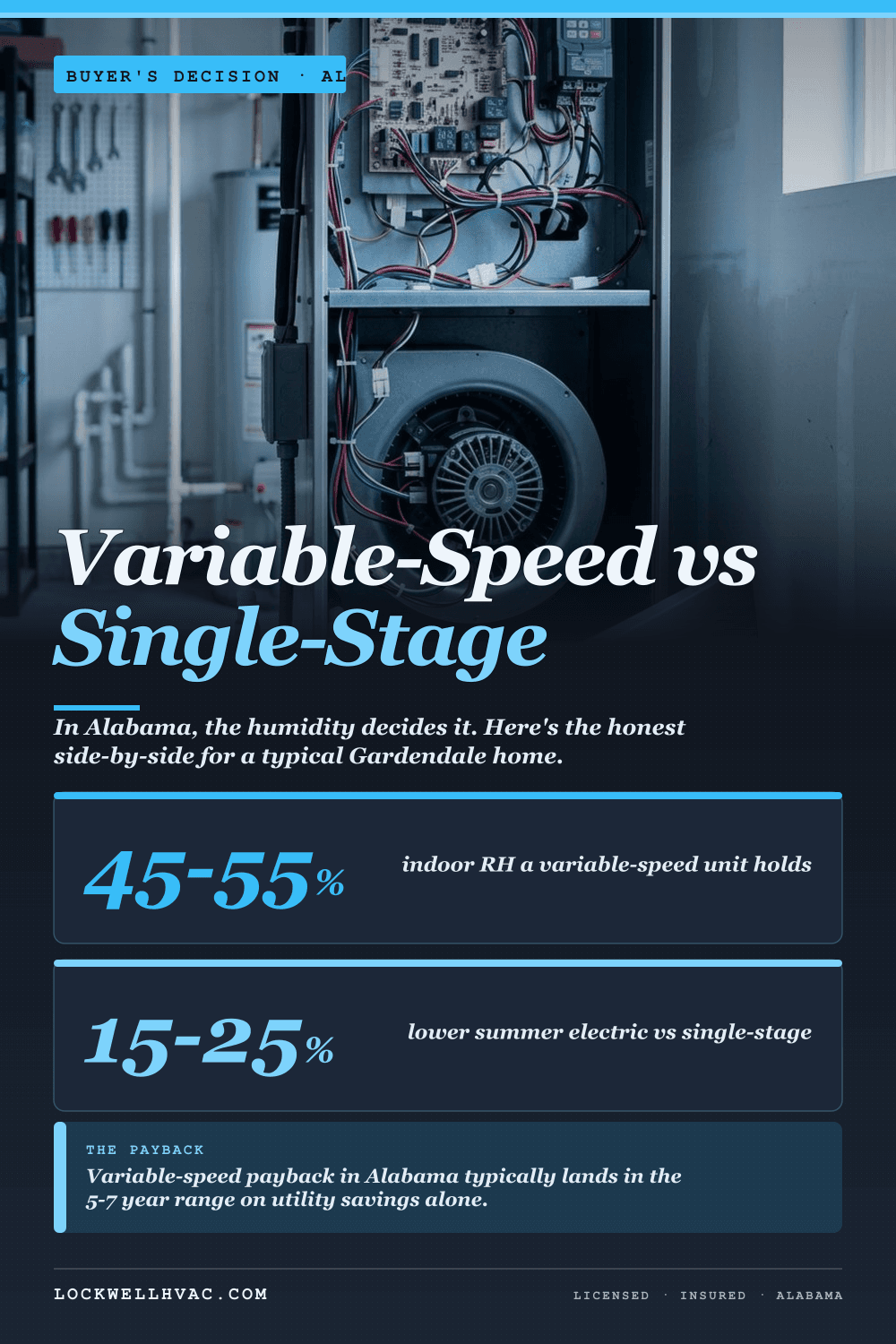
For most Alabama homes, a correctly sized variable-speed system holds indoor humidity between 45% and 55%, cuts summer electric use by 15-25%, and runs near-silent at partial load. Single-stage is cheaper to install and simpler to service, but it cycles harder and manages humidity worse. The decision comes down to envelope tightness, home size, and how much you value humidity control.
What "Variable-Speed" Actually Means
Variable-speed HVAC is equipment that can modulate its output across a continuous range — not just on and off. A true variable-speed compressor runs anywhere from 25% to 100% of rated capacity; a true variable-speed blower (ECM or X13 motor) modulates airflow to match. A single-stage system has one setting: full blast. A two-stage system has two: high and low.
The U.S. Department of Energy publishes the reference standard on residential HVAC equipment types and their efficiency characteristics (https://www.energy.gov/energysaver/central-air-conditioning). For homes in the DOE Southeast region — which includes all of Alabama — SEER2 14.3 is the minimum rating for new split-system central AC as of January 1, 2023. Most variable-speed systems land at 18–22 SEER2. Most single-stage systems land at 14.3–16 SEER2.
Percentage of cooling hours an Alabama HVAC system spends at less than full load during a typical summer. Variable-speed equipment matches that profile; single-stage oversizes it by definition.
The Humidity Argument (The One That Matters Most In Alabama)
Alabama's combination of 93-95°F summer highs and 70-75% relative humidity is the HVAC version of a stress test. The temperature part is solved by sizing. The humidity part is solved by runtime.
A single-stage system runs at full capacity, satisfies the thermostat fast, and shuts off. Indoor humidity creeps up during the off cycle because the evaporator coil is not actively condensing moisture out of the return air. In tight-envelope homes — including most Fultondale and Pleasant Grove rebuild homes — this creates the classic "cold and clammy" feel at 76°F. The thermostat reads satisfied; the human feels miserable.
A variable-speed system runs longer at lower capacity. The evaporator coil stays cold and actively dehumidifying for longer periods. ENERGY STAR guidance (https://www.energystar.gov) cites the 45–55% indoor relative humidity band as the comfort target; variable-speed equipment holds that band reliably in Alabama homes where single-stage drifts above 60%.
This is not a minor preference. Indoor humidity above 60% correlates with mold growth, dust mite populations, and discomfort at otherwise-normal temperatures. The EPA publishes indoor air quality guidance covering the same thresholds (https://www.epa.gov/indoor-air-quality-iaq).
The Runtime Argument
A single-stage 3-ton system in a 1,800 sq ft Gardendale ranch with mid-grade insulation will cycle roughly 6-8 times per hour during a July afternoon. Each cycle is a cold start for the compressor — the moment of highest mechanical stress. Repeated short-cycling is the number-one predictor of premature compressor failure in our field data across Gardendale, Fultondale, and Hueytown service calls.
A correctly sized variable-speed system in the same home runs nearly continuously at 30-40% capacity during the same afternoon. No stops, no starts, no stress. The compressor lasts longer. The blower lasts longer. The electrical contactor — which we replace constantly on single-stage systems in our service territory — never pits because it is never cycling.
The Efficiency Argument (Real Numbers, Not Marketing)
Manufacturer-published SEER2 ratings assume laboratory conditions. Real-world operating efficiency depends on part-load performance. A single-stage 16 SEER2 system running full-blast-then-off averages roughly 12-13 SEER2 in an Alabama summer because cycling losses chew up the rated efficiency. A variable-speed 18 SEER2 system running continuously at 40% load actually delivers close to rated efficiency because it is operating in its design sweet spot.
In dollar terms for a typical Gardendale 1,800 sq ft home: the variable-speed upgrade cuts cooling-season electric use by roughly 15-25% compared to a correctly sized single-stage, according to ENERGY STAR modeling and our own before-and-after utility-bill comparisons from retrofit customers. The upfront cost difference is roughly $1,800-$3,500 depending on tonnage and brand. For a fuller diagnosis of what is actually driving your bill, see why your electric bill is so high in summer Alabama.
Efficiency payback on variable-speed equipment in Alabama typically lands in the 5-7 year range based on utility savings alone — before accounting for longer equipment life and lower service cost.
The Cost Argument
Installed cost, national average, for comparable 3-ton equipment: - Single-stage 14.3 SEER2: lower installed cost, simpler thermostat - Two-stage 16 SEER2: moderate upgrade, compatible with standard smart thermostats like Nest and Ecobee - Variable-speed communicating 18-22 SEER2: higher installed cost, requires matched manufacturer control (Carrier Infinity, Trane ComfortLink II, Lennox iComfort, Bryant Evolution, American Standard AccuLink)
We quote the specific dollar spread on site because it depends on brand, refrigerant (R-454B transition is mostly complete as of 2025 — see EPA AIM Act guidance at https://www.epa.gov/climate-hfcs-reduction), electrical scope, and ductwork condition. Generic online numbers are usually wrong for Alabama.
When Single-Stage Is Actually The Right Answer
Single-stage is the right answer in four cases:
**Small homes under 1,400 sq ft.** Cooling load is small enough that a correctly sized single-stage spends most of its runtime near capacity anyway. The variable-speed benefit is marginal.
**Leaky envelopes that will not be upgraded.** If the infiltration rate is so high that humidity cannot be controlled regardless of equipment, variable-speed cannot fix what is fundamentally a building problem. Spend the money on air sealing first.
**Short-term ownership.** If the homeowner plans to sell in under three years, the payback window does not close.
**Budget-constrained replacements where the existing equipment failed suddenly.** A working single-stage is better than a stretched budget and a financing burden.
When Variable-Speed Is The Right Answer
**Two-story homes.** Variable-speed paired with proper zoning solves the classic "hot upstairs" complaint better than any other combination. See our manufacturers page for the control platforms (https://lockwellhvac.com/manufacturers).
**Tight-envelope newer construction.** Post-2010 Fultondale rebuilds, Pleasant Grove rebuilds, Hillsboro, The Preserve, Buck Creek Trail — humidity will sit above 55% on a single-stage system no matter what you set the thermostat to.
**Homes where occupants are sensitive to humidity, allergens, or noise.** Continuous filtration + continuous dehumidification + near-silent operation is a combination single-stage cannot match.
**Long-term ownership horizons.** 10+ years of residency means the efficiency savings and longer equipment life actually compound.
The Three-Minute Decision Tree
1. Is the home under 1,400 sq ft on a leaky envelope? → Single-stage. 2. Is summer humidity control a frequent complaint? → Variable-speed, assuming budget allows. 3. Is the home two-story with a hot upstairs? → Variable-speed with proper zoning. 4. Is the home a Fultondale or Pleasant Grove rebuild with short-cycling? → Two-stage at minimum, variable-speed if the budget allows. 5. Everything else? → Two-stage is the safe middle choice — most of the humidity and efficiency benefit at a moderate cost premium.
Related Services
- AC Repair across Gardendale, Bessemer, and the Birmingham metro — see /services/ac-repair - HVAC Installation with Manual J load calculation — see /services/hvac-installation - Heat Pump Service — see /services/heat-pump - Manufacturers we install across every tier — see /manufacturers
Need HVAC service in the Birmingham area?
Available 24/7. Licensed and insured. Written estimates before work begins.
Call (205) 206-7030Frequently Asked Questions
Visual Guide
Compiled by the HVAC technicians at Lockwell HVAC in Gardendale, Alabama. The comparisons and explanations here are grounded in what we install and service every week across the North Birmingham metro, so the trade-offs reflect how systems hold up in Alabama homes rather than spec-sheet claims.
- U.S. Department of Energy — Energy efficiency and maintenance guidelines
- ENERGY STAR — Thermostat and installation efficiency standards
- ASHRAE — Coil cleaning and maintenance guidelines
- ACCA — Manual J load calculation standards and equipment lifespan data
- U.S. EPA — Refrigerant regulations and indoor air quality guidance
- NFPA — Electrical safety and fire prevention
- CPSC — Carbon monoxide safety data
- NADCA — Duct cleaning standards
Bookmark this page for reference. Share it with a neighbor who might find it useful. If you have questions about anything covered here, call us directly — a real person answers, not a recording.
Read Next