HVAC Refrigerant Transition: R-410A to R-454B in Alabama (2026 Update)
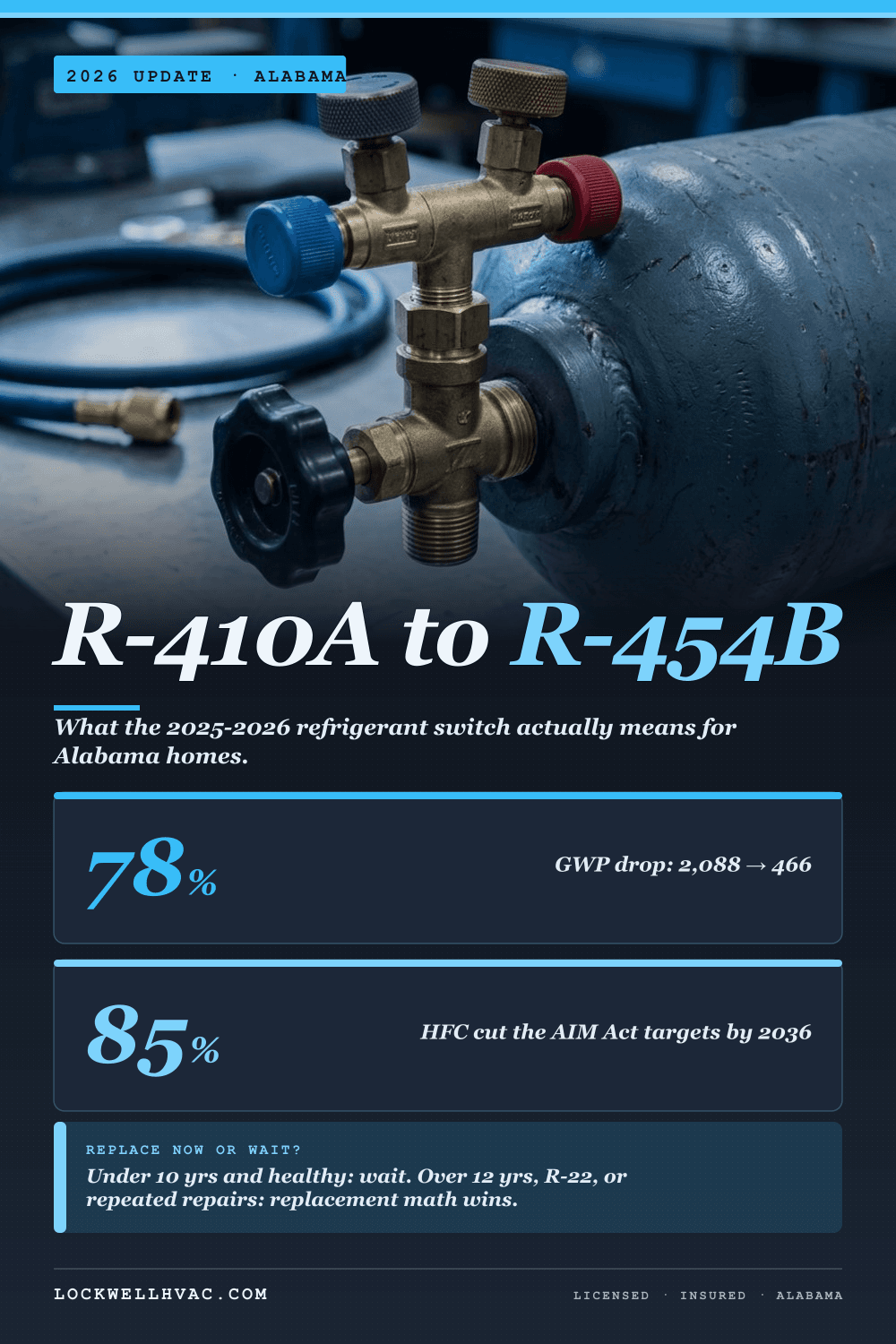
As of 2025-2026, nearly all new residential HVAC equipment installed in Alabama uses R-454B refrigerant instead of R-410A under the U.S. EPA AIM Act phase-down. R-454B has a roughly 78% lower global-warming potential than R-410A. It is classified A2L (mildly flammable), which requires trained technicians and A2L-rated equipment. Existing R-410A systems can continue operating normally — reclaimed R-410A will remain available for service for years to come.
The Big Picture
The U.S. Environmental Protection Agency is phasing down hydrofluorocarbon (HFC) refrigerants under the American Innovation and Manufacturing Act (AIM Act) signed into law in December 2020. The phase-down targets an 85% reduction in HFC production and consumption by 2036 (https://www.epa.gov/climate-hfcs-reduction).
For residential HVAC, the practical effect is that R-410A — the refrigerant used in virtually every residential heat pump and AC sold in the U.S. from roughly 2010 to 2024 — is being replaced in new equipment by R-454B (also marketed as Solstice N41/Opteon XL41 depending on manufacturer). Most major manufacturers — Trane, Carrier, Lennox, Rheem, Bryant, Goodman, American Standard — completed the transition in 2025.
Reduction in global-warming potential (GWP) of R-454B compared to R-410A, per manufacturer and EPA documentation. R-454B GWP is approximately 466 vs R-410A GWP of approximately 2,088.
What Changes With R-454B
**GWP is lower.** R-454B has a global-warming potential roughly 78% lower than R-410A. This is the whole point of the transition.
**It is classified A2L — "mildly flammable."** A2L refrigerants burn only in very specific lab conditions and do not propagate flame the way A3 refrigerants (propane, isobutane) do. The classification drives equipment design requirements — leak detection, restricted charge amounts, certain ventilation requirements for very large charges — but for typical residential equipment, the homeowner-facing impact is minimal.
**Line set sizing is largely the same.** In most cases, the same copper line set used for R-410A works for R-454B. For retrofits of existing line sets, we verify sizing and cleanliness before use.
**Operating pressures are similar.** R-454B operates at pressures close to R-410A but not identical. Suction and head pressures will read slightly different on gauges; manufacturer charging specs control.
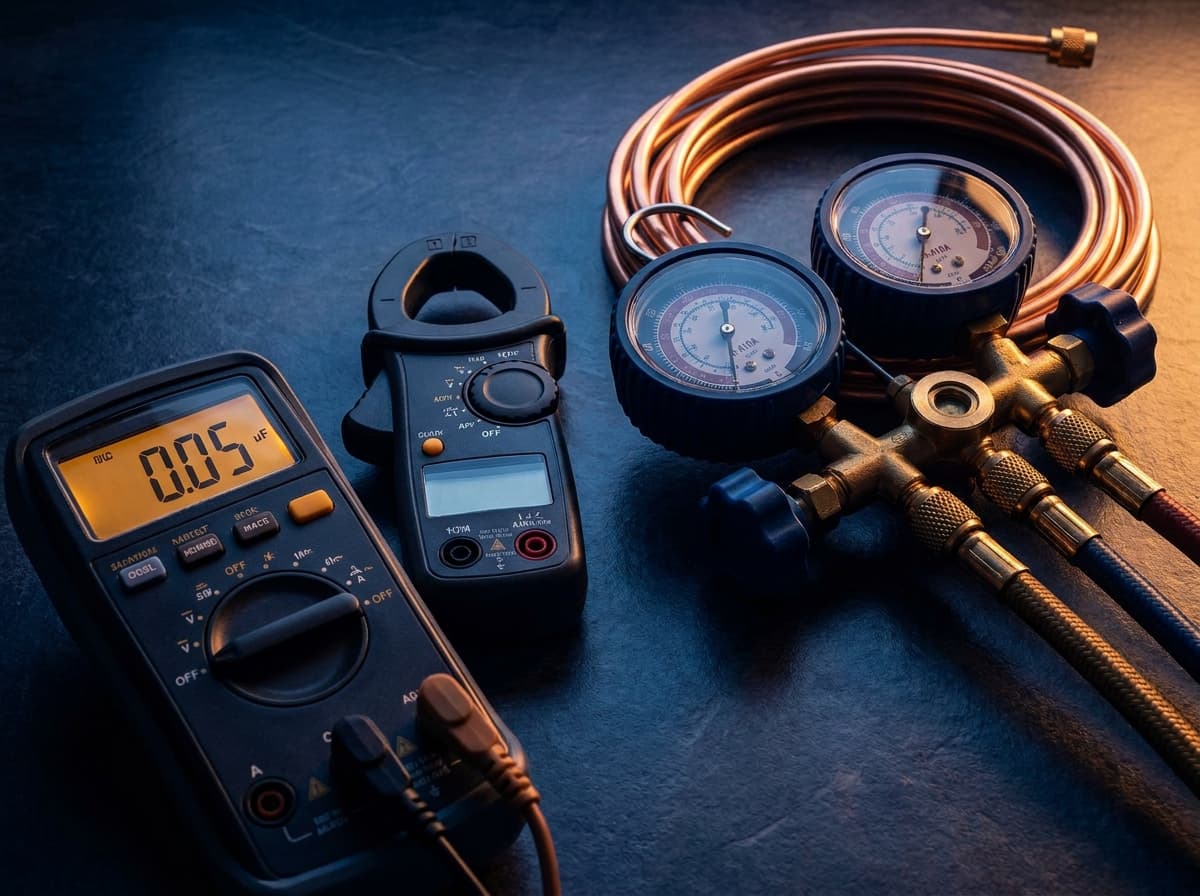
**Service tools require updates.** Refrigerant recovery equipment, recovery cylinders, and leak detectors must be A2L-compatible. Every Lockwell service truck is equipped with A2L-rated tools.
What Does NOT Change
**Existing R-410A systems continue to run.** If your Gardendale home has a 2019 R-410A heat pump, it keeps working. We continue to service R-410A systems normally. Reclaimed R-410A refrigerant is available for service and will remain available for years — similar to how R-22 service has continued well past its 2020 production phase-out (https://www.epa.gov/ods-phaseout).
**Warranty terms are unchanged.** Manufacturer warranties on R-410A equipment remain valid. R-454B warranties follow the same structure — 10-year parts on registered equipment for most major brands.
**System sizing logic is identical.** ACCA Manual J load calculation runs exactly the same whether you end up in R-410A or R-454B equipment (https://www.acca.org/standards/approved-standards).
**Installation process is essentially the same.** Nitrogen pressure test, deep vacuum to 500 microns, weighed charge per manufacturer spec. The commissioning procedure is identical.
Service Implications For Alabama Homeowners
**If your existing system is R-410A and running well:** no action needed. Continue annual maintenance. Your system was not made obsolete by the transition.
**If your existing system is R-410A and needs a major repair (evaporator coil, compressor, refrigerant circuit):** the math gets interesting. Reclaimed R-410A is available but supply tightens every year and pricing rises. For major repairs on older R-410A systems, a full replacement with R-454B equipment may be the better long-term value. We lay out both numbers in writing — repair cost in R-410A vs replacement cost in R-454B — before you decide.
**If your existing system is R-22:** R-22 was phased out for new production on January 1, 2020. Reclaimed R-22 is still legally usable but expensive and shrinking. For R-22 systems with refrigerant leaks, replacement with R-454B is almost always the right answer.
**If you are buying new equipment in 2025-2026:** you will almost certainly get R-454B. Confirm with your contractor and get the AHRI match number in writing (https://www.ahrinet.org/certification/ahri-certification-directory).
Technician Certification Requirements
Every Lockwell technician is EPA Section 608 certified for refrigerant handling (https://www.epa.gov/section608), which is the federal baseline for servicing any refrigerant-containing system. For A2L refrigerants specifically, we maintain additional manufacturer-specific and industry training that covers the A2L-specific tools, leak detection requirements, and service procedures.
Ask any contractor for a current 608 certification and documentation of A2L training. Certification fraud exists in this industry; documentation protects homeowners.
Alabama-Specific Considerations
**Alabama building codes** are based on the International Mechanical Code with state amendments, administered by the Alabama Board of Heating, Air Conditioning, and Refrigeration Contractors (https://hacr.alabama.gov/). The state has adopted updated code language covering A2L refrigerants that aligns with the national transition.
**Alabama Power rebates** on high-efficiency ENERGY STAR equipment continue to apply regardless of refrigerant — R-454B equipment that meets ENERGY STAR thresholds qualifies the same as R-410A did in prior years.
**Birmingham-area climate** (average summer high 94°F, winter low 32°F per NOAA https://www.weather.gov/bmx/climate) favors heat pumps running R-454B over gas furnaces in most of our service territory because heat-pump efficiency is highest in mild-winter climates like ours. We walk through the full tradeoff in heat pump vs furnace for Alabama homes.
The Honest Answer To "Should I Replace Now Or Wait?"
If your existing system is under 10 years old and running well, wait. Replacement-on-purpose rarely makes economic sense for healthy equipment regardless of refrigerant.
If your existing system is over 12 years old, has needed multiple repairs in the last 24 months, or is R-22, the refrigerant transition is one more input supporting replacement. R-454B equipment will be in the market for the next 15+ years, so a replacement today buys you into the long-term supply chain.
If your existing system is 8-12 years old with no major issues, the math is borderline. Get an honest diagnosis. A good contractor will tell you "keep it" if that is the right answer.
Related Services
- AC Repair — see /services/ac-repair - Heating Repair — see /services/heating-repair - HVAC Installation (R-454B equipment) — see /services/hvac-installation - HVAC Maintenance — see /services/maintenance - Manufacturers installing R-454B — see /manufacturers
Need HVAC service in the Birmingham area?
Available 24/7. Licensed and insured. Written estimates before work begins.
Call (205) 206-7030Frequently Asked Questions
Visual Guide
Compiled by the HVAC technicians at Lockwell HVAC in Gardendale, Alabama. The comparisons and explanations here are grounded in what we install and service every week across the North Birmingham metro, so the trade-offs reflect how systems hold up in Alabama homes rather than spec-sheet claims.
- U.S. Department of Energy — Energy efficiency and maintenance guidelines
- ENERGY STAR — Thermostat and installation efficiency standards
- ASHRAE — Coil cleaning and maintenance guidelines
- ACCA — Manual J load calculation standards and equipment lifespan data
- U.S. EPA — Refrigerant regulations and indoor air quality guidance
- NFPA — Electrical safety and fire prevention
- CPSC — Carbon monoxide safety data
- NADCA — Duct cleaning standards
Bookmark this page for reference. Share it with a neighbor who might find it useful. If you have questions about anything covered here, call us directly — a real person answers, not a recording.
Read Next