Heat Pump Sizing for Gardendale & North Birmingham Homes
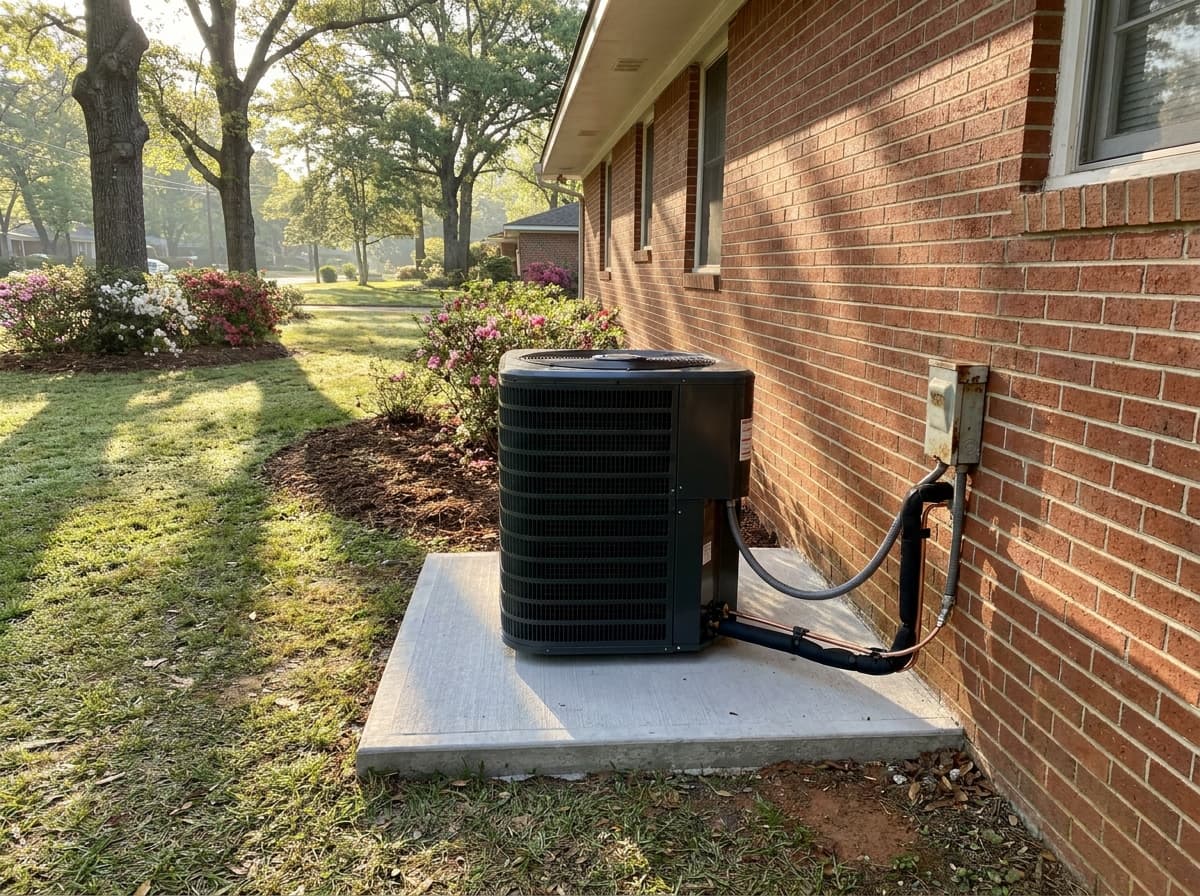
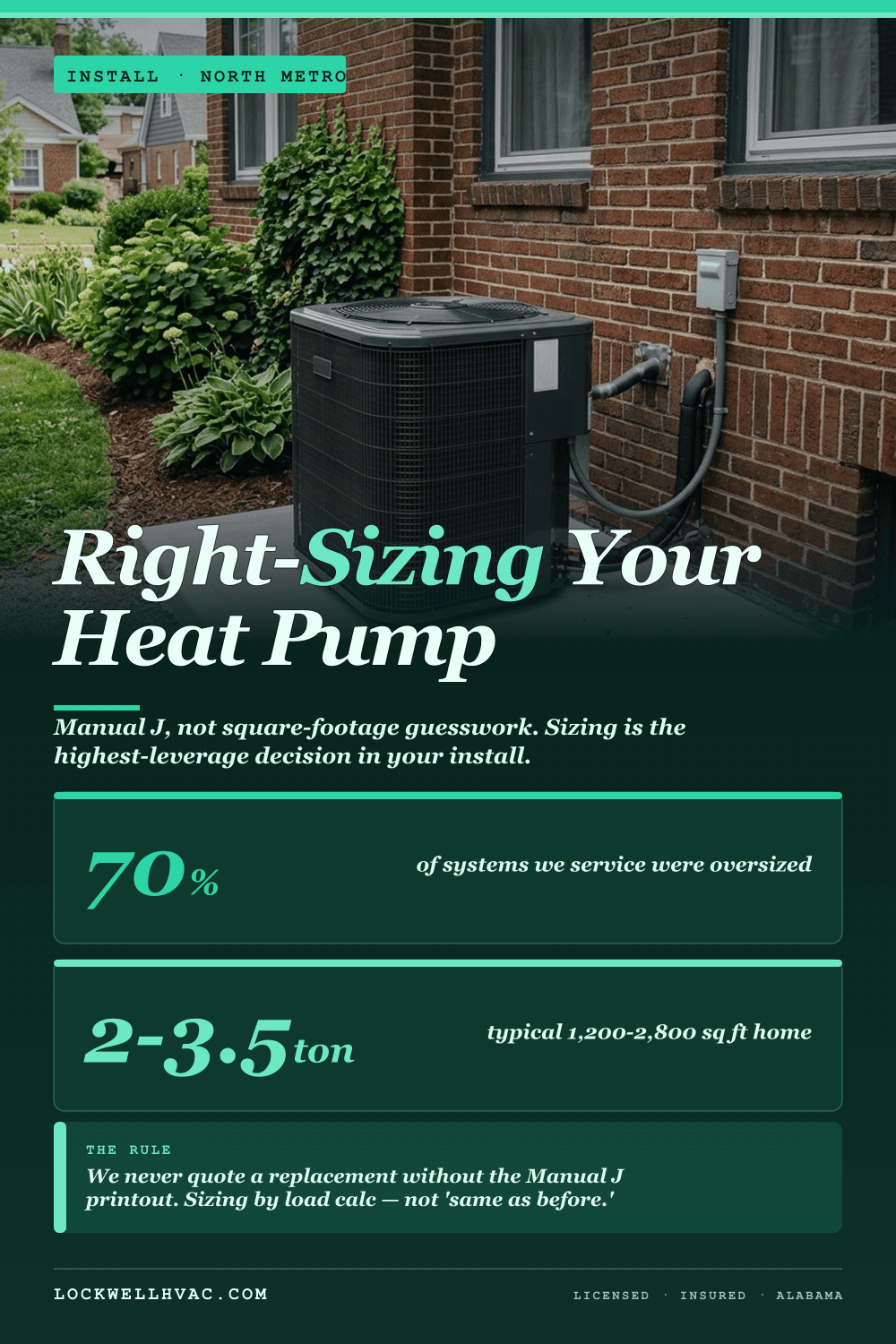
Heat pump sizing is determined by ACCA Manual J — a residential load calculation that accounts for your specific envelope, windows, orientation, insulation, and occupancy. Most Gardendale and north-metro homes in the 1,200-2,800 sq ft range need between 2 and 3.5 tons. Square-footage "rules of thumb" oversize systems in 70%+ of our service territory and are the single biggest preventable cause of humidity complaints, short-cycling, and premature compressor failure.
Why Sizing Matters More Than Brand
Homeowners spend weeks comparing Trane vs Carrier vs Lennox and three minutes thinking about tonnage. It is backwards. A correctly sized mid-tier heat pump will outperform an oversized premium system every day of the year. Sizing is the single highest-leverage decision in a residential HVAC install, and it is the one thing most contractors skip.
The Air Conditioning Contractors of America publishes Manual J as the recognized industry standard for residential load calculations (https://www.acca.org/standards/approved-standards). Manual J is not optional. It is not advisory. It is the method. ENERGY STAR guidance for new installations explicitly requires Manual J sizing (https://www.energystar.gov/products/central_air_conditioners_heat_pumps).
Approximate percentage of residential HVAC systems we service in Gardendale, Fultondale, Hueytown, and Helena that were oversized at original install — most by 30-50% above actual Manual J load.
What Oversizing Actually Does
Contractors oversize for two reasons: it is faster than running Manual J, and it feels safer. Neither is true in practice.
**Short-cycling.** An oversized system satisfies the thermostat quickly and shuts off. Run time per cycle drops below 8-10 minutes. Compressor cold starts triple or quadruple compared to correctly sized. Contactor, capacitor, and compressor all wear faster.
**Humidity fails.** This is the big one. Evaporator coil dehumidification depends on runtime, not capacity. A 3-ton system in a house needing 2.5 tons runs 20% shorter cycles and removes roughly 20% less moisture. In Gardendale's 70%+ summer humidity, that is the difference between comfortable and clammy at the same thermostat setting.
**Efficiency drops.** SEER2 ratings are measured at rated load. A system running at 75% of rated load with cycling losses runs at roughly 70% of rated efficiency. The 17 SEER2 system you paid for delivers 12 SEER2 in reality.
**Comfort complaints.** Temperature drifts room to room. Bedroom is cold, living room is hot. Near the thermostat is fine, everywhere else is off. Zoning retrofits and airflow balancing cannot fully fix a fundamental sizing mismatch.
What Undersizing Does (Rarer, But Worse)
Undersized systems run nearly continuously at full capacity and still cannot hit setpoint on the hottest afternoons. Energy use is high. Compressor wear is high. Homeowner satisfaction is zero. We see undersizing mostly in homes that have been remodeled or added-on to without reassessing HVAC load.
Manual J Inputs That Matter For Gardendale And North Metro Birmingham
**Envelope (walls, windows, insulation).** A 1,600 sq ft 1970s brick ranch on Mt. Olive Road with original insulation has a different load than a 1,600 sq ft 2015 craftsman on Snow Rogers Road with spray-foam attic. Same square footage, very different tonnage. Typical difference: 2.5 tons for the 1970s home vs 2.0 tons for the 2015 home.
**Window area, orientation, and shading.** South- and west-facing glass carries more summer cooling load than north-facing. A heavily shaded lot on Pinchgut Creek Road cuts load by 10-15% vs a full-sun lot with identical envelope.
**Ceiling height and conditioned volume.** A 1,400 sq ft home with 10-foot ceilings has roughly 25% more conditioned air volume than the same floor plan with 8-foot ceilings.
**Infiltration rate.** Leaky 1960s Center Point ranch on Polly Reed Road: 0.7 ACH natural infiltration. Tight 2015 Helena rebuild: 0.2 ACH. Tighter envelope = lower cooling load.
**Duct losses.** Duct system condition and location affects load. Attic ductwork in an Alabama attic picks up 20-30% of conditioned air's heat gain before it reaches the register. Crawl-space ductwork in sealed, insulated space loses almost nothing.
**Occupancy and internal gains.** Number of people, cooking frequency, appliance load, electronics. A 4-person Gardendale home with home-office equipment has higher internal gains than a 2-person empty-nester home with the same floor plan.
Typical Heat Pump Tonnage By House Era For Our Service Territory
Based on roughly 2,000 Manual J calculations we have run across the service area:
- 1,200 sq ft 1960s Center Point ranch: 2.0-2.5 tons - 1,400 sq ft 1970s Hueytown ranch: 2.0-2.5 tons - 1,600 sq ft Gardendale 1990s two-story: 2.5-3.0 tons - 1,800 sq ft Fultondale 2013 rebuild (tight envelope): 2.0-2.5 tons (not 3-ton that contractors default to) - 2,200 sq ft Hillsboro 2010 two-story: 3.0 tons plus zoning - 2,800 sq ft The Preserve premium home: 3.5-4.0 tons, likely two systems or zoning - 3,400 sq ft custom Helena home: 4-5 tons total across two systems
These are starting points, not final numbers. Actual Manual J output controls.
Why Square-Footage Rules Of Thumb Are Wrong
"500 sq ft per ton" is the rule of thumb many contractors still quote. It dates to 1960s housing envelopes. Modern homes with better windows, insulation, and air sealing need substantially less capacity per square foot. A 2,000 sq ft home built to current Alabama energy code often needs 2.5 tons, not the 4 tons a per-sq-ft rule would suggest.
The opposite problem exists for historic homes in Norwood or Fountain Heights. 1910 Queen Anne with 14-foot ceilings and original windows may need more capacity per square foot than the rule suggests because conditioned volume and infiltration are both higher.
The only reliable input is an actual Manual J calculation on the actual home.
How Lockwell Sizes Heat Pumps In Your Home
1. **Envelope walk-through.** Measure exterior walls, insulation levels, window types, ceiling heights, attic condition, and orientation. 2. **Manual J run.** Input everything into Wrightsoft Right-J or equivalent ACCA-approved software. Output is a BTU number per hour at peak cooling and peak heating conditions. 3. **Duct system check.** Measure existing static pressure with a manometer. If static pressure is above 0.8 in. w.c., the new equipment has to be matched to what the duct system can deliver, not just to the Manual J output. 4. **Written recommendation with the Manual J printout.** You see the tonnage, the rationale, and the brand options in the sweet spot. 5. **AHRI-matched quote.** Outdoor condenser + indoor coil + control combination verified on the AHRI Certification Directory (https://www.ahrinet.org/certification/ahri-certification-directory) for warranty coverage.
We do not quote without the Manual J. Contractors who quote over the phone based on square footage are skipping the most important step.
Heat Pump vs Gas Furnace — Alabama Context
Once sizing is settled, the next decision is heat pump vs gas furnace (or dual-fuel). Our full breakdown lives in heat pump vs furnace for Alabama homes. NOAA Birmingham-area climate data (https://www.weather.gov/bmx/climate) shows average winter lows in the low 30s°F — well within the range where modern heat pumps maintain 250-350% efficiency. Operating cost for a correctly sized variable-speed heat pump is lower than electric resistance and competitive with natural gas across our climate.
For homes without existing gas service — most of Bessemer's Jonesboro and Western Hills, most of Hueytown, many Center Point homes — a heat pump is almost always the right answer. For homes with existing gas service, a dual-fuel system that runs the heat pump above ~32°F and switches to gas below is the lowest operating cost combination for Alabama.
Related Services
- HVAC Installation with Manual J load calculation — see /services/hvac-installation - Heat Pump Service — see /services/heat-pump - Duct Cleaning & Sealing (often required before install) — see /services/duct-cleaning - Manufacturers we install — see /manufacturers
Need HVAC service in the Birmingham area?
Available 24/7. Licensed and insured. Written estimates before work begins.
Call (205) 206-7030Frequently Asked Questions
Get the free checklist
Enter your email and we will send the printable PDF to your inbox.
Visual Guide
Compiled by the HVAC technicians at Lockwell HVAC in Gardendale, Alabama. Our installation and sizing notes come from load calculations and equipment swaps on real homes in the North Birmingham metro, where right-sizing and proper startup decide whether a new system actually performs.
- U.S. Department of Energy — Energy efficiency and maintenance guidelines
- ENERGY STAR — Thermostat and installation efficiency standards
- ASHRAE — Coil cleaning and maintenance guidelines
- ACCA — Manual J load calculation standards and equipment lifespan data
- U.S. EPA — Refrigerant regulations and indoor air quality guidance
- NFPA — Electrical safety and fire prevention
- CPSC — Carbon monoxide safety data
- NADCA — Duct cleaning standards
Bookmark this page for reference. Share it with a neighbor who might find it useful. If you have questions about anything covered here, call us directly — a real person answers, not a recording.
Read Next