For Birmingham homes
BTU Calculator. For one room.
Right-size the cooling for any single room in your Alabama home. The formula is the ACCA Manual J residential rule of thumb, adjusted for Birmingham's humid Cfa climate. Free, no email required, no upsell.
Inputs
Tell us about the room.
Result
Required cooling capacity
5,600 BTU/hr
Approximately 0.47 tons of cooling across 224 sq ft.
Suggested equipment class
5,000 BTU window unit
Estimate based on ACCA Manual J residential rules of thumb. A real load calculation accounts for window orientation, infiltration, and duct losses we can't see from this form.
Need a real Manual J load calc?
We measure your house room-by-room, check the duct static, and put the right size on paper before any equipment quote.
Call (205) 206-703002 · The formula
Where the number comes from.
Every legitimate residential cooling-load formula starts the same way: square footage times a base BTU/sq ft factor for the climate, then adjusted for everything that changes the load — ceiling height, insulation R-value, window orientation, and occupant heat.
The base rate
We use 25 BTU per square foot because Birmingham sits in the humid subtropical Cfa climate zone. Dry-climate calculators (Denver, Phoenix) use 18–20. Wet-climate calculators (Houston, Miami) use 28–32. Twenty-five is the right anchor for Alabama.
Ceiling adjustment
The 25 BTU/sq ft baseline assumes an 8-foot ceiling. A 10-foot ceiling means 25% more air volume to cool. The calculator multiplies by (ceiling / 8) automatically — vaulted Birmingham bungalows are routinely undersized because the previous installer forgot this step.
Insulation modifier
A 1965 brick ranch in Center Point with original single-pane windows and R-11 attic insulation needs 15% more cooling than a 2018 build with R-49 attic and double-pane low-E glass. The modifier handles the gap.
Sun exposure
A west-facing master bedroom over a Gardendale driveway gets baked from 2 PM until sundown in July. We add 15% over baseline. North-facing rooms with mature tree cover get 10% off. Sunrooms and glass-walled additions are special cases — call us.
Occupant adder
Every adult occupant beyond the first two adds about 600 BTU/hr of sensible and latent heat. A bedroom occupied by two people is the base case; a home office with a dad, a dog, and three monitors is a different problem.
Source standards
The full residential cooling-load standard is ACCA Manual J 8th Edition and ASHRAE Handbook — HVAC Applications. Every Lockwell HVAC installation begins with a measured Manual J using residential load-calculation software, not this rule of thumb.
03 · How to use it
Five-step process.
Measure the room
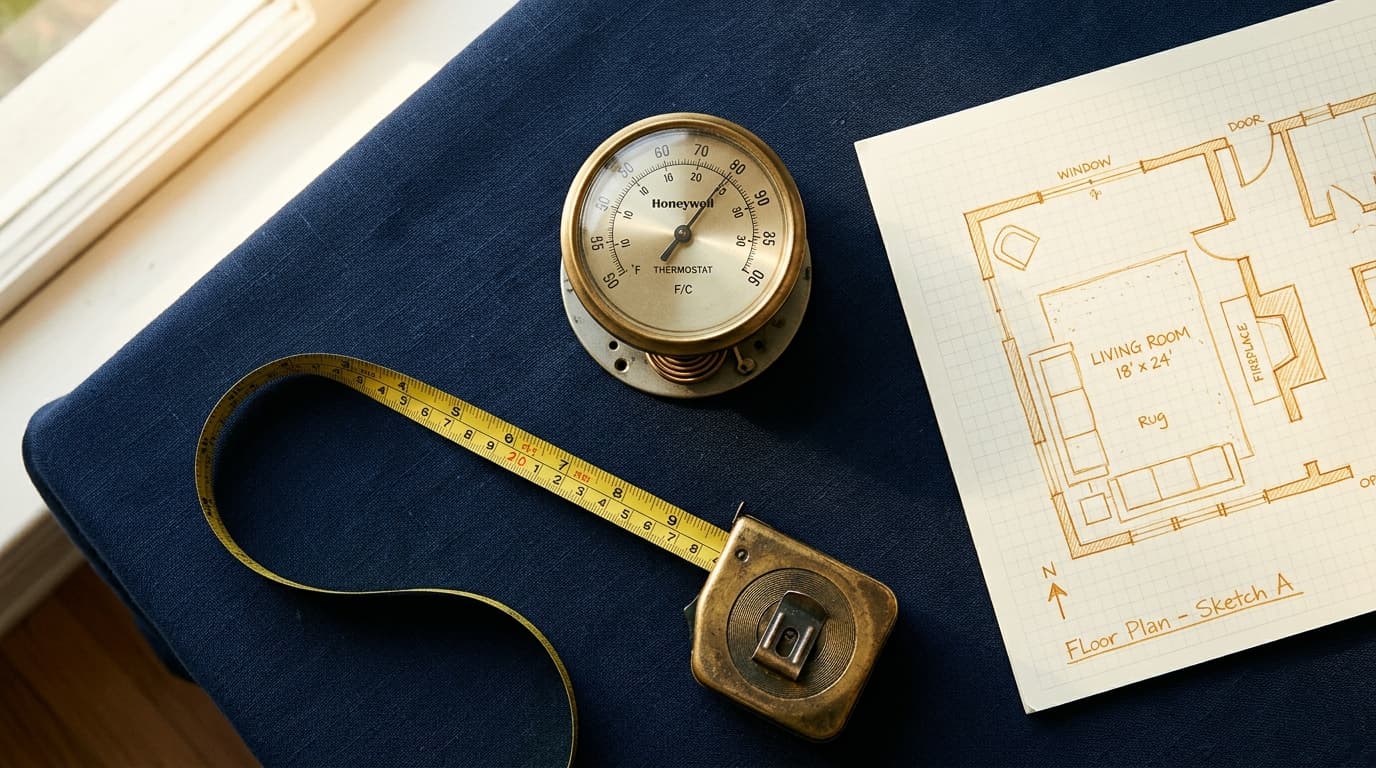
Pull a tape measure across the length and width of the room. Round to the nearest foot. If the room is L-shaped, treat each rectangle separately and add the BTU numbers together.
Note the ceiling height
Most homes are 8 ft. Vaulted, tray, or older homes with 9–12 ft ceilings need the proportional adjustment — the calculator handles this automatically.
Assess insulation honestly
If you can hear road noise inside on a calm day, your insulation is below average. If your power bill spikes hard in July, you have a sun-exposure or duct-leak problem the BTU number alone will not solve.
Count typical occupants
The base formula assumes 2 occupants. Each additional regular occupant adds 600 BTU/hr — body heat is real cooling load in a tight room.
Compare to your existing equipment
If the calculator gives you 24,000 BTU and your installed unit is a 2-ton (24,000 BTU), you are sized correctly. If your unit is 18,000 BTU and the calculator says 30,000, the equipment is the bottleneck — not the thermostat.
04 · If the number worries you
Three services that fix sizing problems.
HVAC Installation
Every new system gets a measured Manual J. Right-size the equipment, pull the permit, verify startup.
Duct Cleaning & Sealing
A correctly sized AC paired with leaky ductwork loses 20–30% of its capacity into your crawl space. Test, seal, recover the BTU.
AC Repair
If your existing equipment is sized right and still not cooling, the issue is mechanical — capacitors, refrigerant, coils. We diagnose, you decide.
05 · Questions
BTU questions, answered straight.
When the calculator is not enough
Need a real load calc on paper?
We measure the house room by room, check duct static, and put the right-size equipment number on paper before any quote.
Call (205) 206-7030